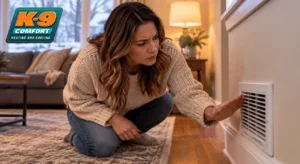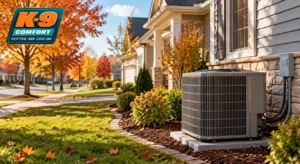
It’s one of the most common questions homeowners ask when a furnace starts acting up — or when an HVAC technician mentions the word “replacement.” How long is a furnace actually supposed to last? And is yours approaching the end of its useful life, or does it have years left? K9 Comfort Heating & Cooling works with homeowners across Marion, Marysville, Delaware, and Central Ohio to answer that question honestly — with documented diagnostic findings rather than a sales pitch.
This guide covers average furnace lifespan, what affects it, how Ohio’s climate factors in, and how to tell whether your furnace is aging well or quietly declining.
The Short Answer: 15–20 Years, With Caveats
Most gas furnaces have a functional lifespan of 15–20 years. That range is widely cited because it’s consistently supported by industry data — but the caveats matter as much as the number itself.
A furnace that receives annual professional maintenance, was correctly sized when installed, and operates in a reasonably well-insulated home can reach 20 years or beyond. A furnace that runs without regular service, was incorrectly sized, or heats a home with significant air leakage and duct problems often falls short of 15 — sometimes well short.
The honest answer isn’t just a number. It’s a number shaped by how the furnace has been treated, how well it was installed, and what it’s been asked to do every winter. Central Ohio’s climate is demanding on both ends — hot, humid summers stress cooling equipment, and sustained cold winters push heating systems hard. That context matters when evaluating how much life your furnace has left.
What Affects Furnace Lifespan
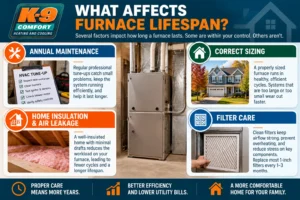
Several factors have a meaningful impact on how long a furnace lasts. Some are within your control. Others aren’t.
Annual Maintenance
This is the single biggest controllable factor. A furnace that receives a thorough professional tune-up every fall — heat exchanger inspection, burner cleaning, ignitor and flame sensor testing, blower motor check, safety device verification — consistently outlasts one that doesn’t.
Annual maintenance catches small problems before they become large ones. A worn ignitor identified at a tune-up is a $150 repair. An ignitor that fails on a cold January night is an emergency service call at premium rates. More importantly, deferred maintenance allows small issues to compound — a dirty heat exchanger runs hotter, stresses components, and shortens the system’s overall lifespan in ways that accumulate invisibly year over year.
Correct Sizing at Installation
A furnace that was correctly sized for the home when it was installed runs in longer, more efficient cycles. It heats the space, satisfies the thermostat, and shuts down — completing the job it was designed to do.
An oversized furnace short-cycles — turning on and off too frequently because it heats the space faster than the thermostat can register. Short-cycling is hard on components. The repeated stress of starting and stopping puts wear on the ignitor, heat exchanger, and blower motor at a rate that meaningfully shortens equipment life. A furnace that short-cycles its entire operational life will almost always fail earlier than one that runs properly sized cycles.
Undersized furnaces have the opposite problem — they run too long, too often, under too much load. The result is the same: accelerated wear and a shorter lifespan.
Home Insulation and Air Leakage
A well-insulated home with minimal air leakage doesn’t ask as much of its furnace. The system heats the space, the heat stays in, and the furnace runs fewer cycles to maintain temperature. A drafty, poorly insulated home requires the furnace to run longer and more frequently to compensate for heat loss — and more run time means more wear.
This is one reason older homes in Central Ohio — particularly those built before modern insulation standards — tend to be harder on HVAC equipment. Addressing insulation and air sealing doesn’t just reduce energy bills. It directly reduces the workload on the heating system and extends its useful life.
Filter Maintenance
A clogged air filter restricts airflow across the heat exchanger. The furnace overheats, trips its limit switch, and shuts down prematurely — then restarts and repeats the cycle. That repeated overheating stresses the heat exchanger and other components in ways that accumulate over time.
Most standard 1-inch filters need replacement every 1–3 months during heavy use seasons. Thicker media filters last longer but still need periodic inspection. This is the simplest and least expensive maintenance task a homeowner can perform — and skipping it consistently is one of the fastest ways to shorten a furnace’s lifespan.
Equipment Quality
Not all furnaces are built to the same standard. Budget equipment installed at the lowest possible price point typically uses lower-grade components with shorter rated lifespans. Better equipment from established manufacturers — installed correctly, sized properly, and maintained annually — simply lasts longer.
This is one reason the lowest bid on a furnace replacement isn’t always the best value. A quality system installed and maintained properly will outlast a budget system by years, often making the higher upfront cost the lower long-term expense.
How Ohio’s Climate Affects Furnace Lifespan
Central Ohio isn’t the most demanding climate in the country for heating equipment — but it’s not mild either. Marion, Delaware, Marysville, and the surrounding area regularly see temperatures drop into the single digits and below zero during January and February. That sustained cold puts real load on heating systems in ways that milder climates don’t.
A furnace in Central Ohio runs more hours per heating season than the same furnace would in a southern climate. More run hours mean more wear — on burners, heat exchangers, blower motors, and ignition components. Everything else being equal, a furnace in Ohio will accumulate operational wear faster than the same model would in Georgia or the Carolinas.
This is worth keeping in mind when evaluating a furnace that’s approaching the 12–15 year mark. A system at that age in a demanding climate deserves a more careful evaluation than the same age system in a mild one.
The Heat Exchanger: Why It’s the Real Lifespan Indicator
If you want to know how much life a furnace has left, the heat exchanger is the component to watch. The heat exchanger separates combustion gases — including carbon monoxide — from the air that circulates through your home. It experiences extreme thermal stress every time the furnace cycles — expanding when hot, contracting when cool — thousands of times over its lifetime.
Eventually, that thermal cycling causes fatigue. Cracks develop. When the heat exchanger cracks, combustion gases can enter the airstream. That’s a safety issue, not just an efficiency issue — and a cracked heat exchanger on an older furnace is almost always the point at which replacement becomes the honest recommendation rather than repair.
Most heat exchangers are rated for 15–20 years of normal operation. On a furnace approaching that age, annual inspection of the heat exchanger isn’t optional — it’s the most important safety check in the maintenance visit.
Signs Your Furnace Is Aging Out
Age alone isn’t always enough to make a replacement decision. The condition of the system matters alongside the calendar. Here are the signs that a furnace is genuinely declining — not just aging.
- Energy bills increasing year over year without a clear change in usage or weather patterns
- More frequent repairs — two or more service calls in a season is a pattern, not bad luck
- Uneven heating — rooms that were comfortable before are now consistently cold
- New noises — banging, rumbling, or squealing that wasn’t present in previous seasons
- Yellow or flickering flame — a sign of combustion problems that may indicate heat exchanger issues
- Excessive dust or dry air — aging furnaces lose their ability to properly condition and filter air
- The system struggles to maintain temperature on the coldest Ohio days
Any one of these in a furnace over 15 years old is a signal worth taking seriously. Several of them together make the case for a professional evaluation before the next heating season.
Furnace Lifespan by the Numbers
| Scenario | Expected Lifespan |
|---|---|
| Well-maintained, correctly sized, good insulation | 18–22 years |
| Maintained annually, average home conditions | 15–18 years |
| Inconsistent maintenance, average conditions | 12–15 years |
| Rarely or never maintained | 10–13 years |
| Oversized or undersized at installation | 10–14 years |
| High-demand climate, heavy use season | Subtract 1–2 years from any category |
These ranges are generalizations — individual systems vary. However, they illustrate how meaningfully maintenance and sizing decisions affect the actual service life of a furnace investment.
When to Repair and When to Replace
Knowing your furnace’s age and condition is useful context. Knowing how to apply that context to a repair-versus-replace decision is where it becomes actionable.
A few practical guidelines:
Repair is usually the right call when:
- The furnace is under 10 years old and the repair is straightforward
- The repair cost is well under 50% of the system’s replacement value
- No other signs of overall decline are present
Replacement deserves serious consideration when:
- The furnace is 15 years old or older and requires a significant repair
- Repair cost exceeds 50% of what a new system would cost
- The heat exchanger is cracked or compromised
- Multiple components have failed in a short period
- Energy bills have risen steadily despite recent repairs
Replacement is almost always the right answer when:
- The furnace is over 20 years old
- The heat exchanger has failed on a system over 15 years old
- The system uses R-22 refrigerant or components that are no longer manufactured
At K9 Comfort, we never recommend replacement without showing you the reasoning behind it. Every evaluation includes documented diagnostic findings and a clear comparison of repair cost versus replacement value — so you have the information to make the right decision for your home and your budget. You can explore what furnace replacement looks like on our heating services page.

The Role of Annual Maintenance in Maximizing Furnace Life
The difference between a furnace that lasts 12 years and one that lasts 20 often comes down to one thing: whether it received consistent annual maintenance. That’s not a sales pitch — it’s what the data supports.
Annual maintenance keeps combustion operating cleanly, catches components before they fail, ensures the heat exchanger is inspected every season, and keeps the system running at rated efficiency. A furnace maintained this way reaches its full design life. One that doesn’t, doesn’t.
K9 Comfort provides thorough, documented furnace maintenance across Central Ohio — not a quick once-over, but a systematic inspection with findings you can see. Our AC maintenance services page covers what a full preventive maintenance visit includes for both heating and cooling systems.
FAQ
Is a 20-year-old furnace too old to repair?
Generally, yes — with some nuance. A 20-year-old furnace that requires a minor repair and has been well-maintained might still have a year or two of useful life. However, a 20-year-old furnace requiring any significant repair — heat exchanger, control board, inducer motor — has almost certainly crossed the threshold where replacement is the better financial and safety decision. At that age, the next repair is rarely the last one.
Does a furnace lose efficiency as it ages?
Yes. Efficiency degrades gradually over time as burners accumulate deposits, heat exchanger surfaces oxidize, and blower motors wear. A furnace rated at 80% AFUE when new may be operating significantly below that after 15 years without maintenance. Annual service slows that degradation but doesn’t stop it entirely. Modern high-efficiency systems at 96–98% AFUE represent a meaningful efficiency upgrade over aging equipment regardless of condition.
Should I replace my furnace before it fails completely?
In most cases, yes — particularly once it passes the 15-year mark and shows signs of decline. Planned replacement in fall is almost always less expensive and less stressful than emergency replacement in January. You have time to evaluate options, compare systems, and make a decision that fits your budget rather than one driven by cold temperatures and urgency.
Does a new furnace pay for itself in energy savings?
It depends on the efficiency of the existing system and current energy costs. Replacing an 80% AFUE furnace with a 97% AFUE system eliminates roughly 17 cents of wasted fuel for every dollar spent on gas — a meaningful difference over a full Ohio heating season. The payback period varies, but for homeowners with older, inefficient systems, the monthly savings are often more significant than expected.
How do I find out how old my furnace is?
The manufacture date is typically encoded in the furnace’s serial number. Most manufacturers use a format where the first few digits indicate the year or week and year of manufacture. The model and serial number are on a label inside the furnace cabinet — usually on the front panel or near the burner compartment. If you’re unsure how to read it, a technician can decode it during a service visit.
Not Sure How Much Life Your Furnace Has Left?
The honest answer starts with a professional evaluation — not a guess based on age alone. K9 Comfort Heating & Cooling inspects and documents furnace condition across Marion, Delaware, Marysville, and Central Ohio, and we’ll tell you exactly where your system stands — with the data to back it up.
Call us: (740) 361-7748
Schedule online: k9comfort.ai/contact-k9-comfort-in-marion
We serve Marion, Marysville, Delaware, Dublin, Lewis Center, Powell, Bucyrus, Upper Sandusky, Sunbury, and the surrounding Central Ohio area. Same family. Same standards. Every visit.

External References
- U.S. Department of Energy — Furnace Efficiency and Lifespan: https://www.energy.gov
- ENERGY STAR — Furnaces and Heating Equipment: https://www.energystar.gov
- Carrier — Furnace Products and Longevity: https://www.carrier.com
- Lennox — Furnace Maintenance and Lifespan: https://www.lennox.com
- Trane — Heating Systems: https://www.trane.com