Few things are more unsettling on a cold Ohio morning than reaching your hand up to a heating vent and feeling cold air. The heat pump is running — you can hear it — but what’s coming through the vents isn’t warm. Before you call for emergency service or assume the worst, it helps to understand what’s actually happening. Some causes of a heat pump blowing cold air are completely normal. Others require prompt attention. K9 Comfort Heating & Cooling helps homeowners across Marion, Delaware, Marysville, Powell, and Central Ohio sort out the difference — quickly and honestly.
This guide walks through every common reason a heat pump blows cold air in heating mode, how to identify which one applies to your situation, and what to do next.
First: Is the Cold Air Actually a Problem?
This is the most important question to answer before doing anything else. Heat pumps blowing cooler-than-expected air is sometimes completely normal — and misunderstanding that leads to unnecessary service calls.
Here’s what normal looks like versus what isn’t.
| Situation | Normal or Problem? |
|---|---|
| Air feels warm but not hot — around 90–100°F | Normal — heat pumps run cooler than furnaces |
| Cool air for 5–15 minutes at startup | Usually normal — system is reaching operating temperature |
| Cool or cold air during defrost cycle | Normal — temporary, lasts 5–15 minutes |
| Steam rising from outdoor unit briefly | Normal — part of the defrost cycle |
| Cold air continuously for more than 20 minutes | Problem — investigate further |
| Air feels the same temperature as the room or colder | Problem — system is not heating |
| Indoor temperature dropping while system runs | Problem — call for service |
If the air coming from your vents feels warm — even if it’s warmer than room temperature — your heat pump is almost certainly working. Heat pumps deliver air between 90–100°F, which feels noticeably cooler than the 120–140°F air a gas furnace produces. Many homeowners assume a heat pump is malfunctioning when it’s actually working exactly as designed.
If the air genuinely feels cold — the same temperature as the room or colder — keep reading.
Cause #1: The System Is in Defrost Mode
This is the most common reason a heat pump blows cold air on a winter day — and it’s not a malfunction at all.
Heat pumps extract heat from outdoor air. During cold weather, moisture in that air freezes on the outdoor coil. To clear the ice, the system periodically reverses operation — temporarily running in cooling mode to warm the outdoor coil and melt the frost. During this defrost cycle, cold air may blow through indoor vents for 5–15 minutes.
Signs you’re in defrost mode include steam or vapor rising from the outdoor unit, the outdoor fan stopping while the compressor continues to run, and a brief hissing or whooshing sound from the outdoor unit. The system should return to normal heating operation once defrost is complete.
What to do: Wait 10–15 minutes. If the system returns to delivering warm air, defrost mode was the cause and no action is needed.
When to be concerned: If the system runs in what appears to be defrost mode continuously — more than 20–30 minutes without returning to normal heating — the defrost control board or defrost sensor may be malfunctioning. That warrants a service call.
Cause #2: The Thermostat Is Set Incorrectly
It sounds obvious — but incorrect thermostat settings cause a meaningful number of cold air complaints, especially after seasonal transitions when someone switches between heating and cooling mode.
Check the following:
- The thermostat is set to HEAT, not COOL or FAN
- The set temperature is at least 3–5 degrees above the current room temperature
- The system mode is set to AUTO, not FAN only — FAN only circulates unconditioned air without activating the heat pump
If the thermostat is in FAN mode, it’s circulating air from the return vents — which pulls cooler air from unconditioned spaces like basements, crawl spaces, or attics — without activating the heating system. The result is a steady stream of cool air that feels exactly like a heat pump problem.
What to do: Confirm all settings and give the system 5–10 minutes to respond after making changes.
Cause #3: The Reversing Valve Is Stuck
The reversing valve is the component that switches a heat pump between heating and cooling mode. It’s a four-way valve that directs refrigerant flow — one direction for heating, the other for cooling.
When a reversing valve sticks or fails, the system may get locked in cooling mode. That means the heat pump actively removes heat from your home rather than adding it — delivering cold air through the vents while the system runs normally in every other way. The outdoor unit hums, the indoor air handler blows, the thermostat calls for heat — but the house gets colder.
This is one of the most commonly misdiagnosed heat pump problems because the system appears functional from the outside. A stuck reversing valve requires a technician to diagnose with refrigerant pressure measurements and temperature readings — not a visual inspection alone.
What to do: If defrost mode and thermostat settings have been ruled out and the air is genuinely cold, a stuck reversing valve is a likely culprit. Call for a diagnostic service visit. Our heat pump services page covers what a proper heat pump diagnostic looks like.
Cause #4: Low Refrigerant
Refrigerant is the substance that moves heat from one place to another. In heating mode, the heat pump uses refrigerant to absorb heat from outdoor air and transfer it inside. A system low on refrigerant loses that ability — it may blow air, but without adequate refrigerant charge, it can’t pick up and transfer meaningful heat.
Low refrigerant always means a leak somewhere in the system. Refrigerant doesn’t get used up like fuel — if the level is low, it escaped through a crack, a faulty fitting, or a damaged component.
Signs of low refrigerant alongside cold air from vents include ice forming on the refrigerant lines or outdoor coil, a hissing or bubbling sound near the unit, and the system running continuously without reaching set temperature.
Adding refrigerant without finding and repairing the leak is a temporary fix that will fail again — sometimes within weeks. A proper repair locates the leak, fixes it, and then recharges the system to manufacturer specifications.
What to do: Turn the system off if you see significant icing and call for service. Do not continue operating a system that may be low on refrigerant — running the compressor without adequate refrigerant can cause permanent compressor damage.
Cause #5: A Clogged Air Filter Restricting Airflow
A severely clogged air filter restricts the airflow the heat pump needs to operate effectively. When airflow is restricted, the system struggles to transfer heat into the air stream — even when the heat pump itself is functioning correctly.
In extreme cases, restricted airflow causes the indoor coil to freeze over, which compounds the problem by blocking airflow further. The result is air that feels cold or barely warm regardless of how the system is set.
This is one of the most preventable causes of heat pump cold air problems. A filter that should be replaced every 1–3 months — left in place for six months or longer — can restrict airflow dramatically.
What to do: Locate your air filter, pull it out, and hold it up to light. If you can’t see light through it, replace it immediately. After replacing the filter, give the system 20–30 minutes to recover. If icing occurred, the system may need a few hours with the fan running to fully thaw before resuming normal operation.
Cause #6: Outdoor Temperature Below the System’s Efficient Range
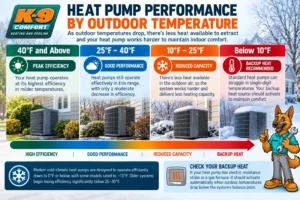
Heat pumps extract heat from outdoor air. As outdoor temperatures drop, there’s less heat available to extract — and the system works progressively harder to maintain the same indoor temperature.
Standard heat pumps begin losing efficiency significantly below 25–30°F. On an extreme Central Ohio cold snap — single digits or below zero — an older or standard-efficiency heat pump may genuinely struggle to deliver warm air, even when functioning correctly. The air coming from the vents may feel noticeably cooler than normal during these periods.
Modern cold-climate heat pumps are designed to operate efficiently down to 0°F or below, with some models rated to -13°F. Older systems don’t carry these ratings.
If your heat pump has a backup heat source — electric resistance strips or a gas furnace in a dual-fuel setup — that backup should activate automatically when outdoor temperatures drop below the system’s balance point. If the backup isn’t activating, a thermostat setting or wiring issue may be preventing it.
What to do: Check the outdoor temperature. If it’s in the single digits and your system is older, reduced heating capacity is expected. Confirm the backup heat is activating if your system has one. If outdoor temperatures are moderate and the system still blows cold, the cause is something else on this list.
Cause #7: An Electrical Component Failure
Capacitors start the compressor and fan motors. When a capacitor fails, the compressor may not start properly — the system attempts to run but can’t complete a full refrigeration cycle. The indoor air handler blows air, but without the compressor operating correctly, that air isn’t being heated.
Similarly, a contactor failure — the electrical switch that allows power to reach the outdoor unit — can prevent the outdoor unit from running while the indoor air handler continues to operate. The result is indoor air blowing at room temperature or slightly below, since unconditioned air from return vents is being circulated without any heat added.
Both capacitors and contactors are relatively common failure points — particularly on systems more than 8–10 years old — and both require a technician to diagnose and replace safely.
What to do: If the outdoor unit is not running while the indoor air handler is blowing, an electrical component failure is a likely cause. Do not attempt to inspect or repair capacitors yourself — they store dangerous electrical charge even when power is disconnected.
What to Check Before Calling for Service
Work through this list before scheduling a service call. These steps resolve a meaningful percentage of heat pump cold air situations without a technician visit.
- Confirm thermostat settings — HEAT mode, set temperature above room temperature, AUTO not FAN
- Wait through a potential defrost cycle — 10–15 minutes of cold air followed by a return to warm is normal
- Check and replace the air filter if it’s been more than 2–3 months since the last change
- Check the circuit breakers — both the indoor air handler and outdoor unit have separate breakers
- Check the outdoor unit — is it running? Is it heavily iced over? Is it making unusual sounds?
If none of these resolve the issue — or if the outdoor unit is completely iced over, making unusual sounds, or not running at all — it’s time for a professional diagnostic visit. Our heating services page covers what to expect when you call K9 Comfort for a heat pump service visit.

FAQ
Why does my heat pump blow cold air when it’s really cold outside?
Heat pumps extract heat from outdoor air. As outdoor temperatures drop — especially below 25–30°F — there’s less available heat to extract and the system works harder to deliver the same result. On Central Ohio’s coldest days, standard heat pumps may deliver noticeably cooler air than usual. Modern cold-climate systems are designed to handle extreme temperatures more effectively. If your system has backup heat, confirm it’s activating on very cold days.
How long does the heat pump defrost cycle last?
A normal defrost cycle lasts between 5 and 15 minutes. During that time, the system temporarily reverses to cooling mode to melt frost from the outdoor coil — which means cold air through indoor vents. After the cycle completes, the system returns to heating mode. If your system appears to be running defrost cycles continuously or for more than 20–30 minutes without returning to normal heating, the defrost control board may be malfunctioning.
Can a dirty filter cause my heat pump to blow cold air?
Yes. A severely clogged filter restricts the airflow the heat pump needs to transfer heat into the air stream effectively. In extreme cases it can cause the indoor coil to freeze over, compounding the problem. Replacing a clogged filter is the first thing to check when a heat pump starts delivering noticeably cooler air — it’s free and takes two minutes.
My heat pump worked fine last winter. Why is it blowing cold air now?
Several components can degrade over a single season — capacitors, reversing valves, refrigerant charge, and defrost controls all have finite service lives. A component that was marginal last winter may have reached failure this fall. Additionally, reversing valve issues sometimes develop over the summer — the valve is used in cooling mode all summer and may stick when asked to switch back to heating mode in fall.
Should I switch to emergency heat if my heat pump is blowing cold air?
Emergency heat bypasses the heat pump entirely and uses electric resistance strips — the equivalent of a giant electric space heater — to warm the home. It’s effective but significantly more expensive to operate than a properly functioning heat pump. Use it as a temporary measure if your home is uncomfortably cold and you’re waiting for service — but don’t leave it in emergency heat mode long term. It’s a bridge, not a solution.
Heat Pump Blowing Cold Air? Let’s Figure Out Why.
Cold air from a heat pump in winter can mean several things — some normal, some serious. The right answer starts with the right diagnosis. K9 Comfort Heating & Cooling diagnoses heat pump problems across Central Ohio with documented findings and clear options before any work begins. No guesswork, no pressure, just straight answers.
Call us: (740) 361-7748
Schedule online: k9comfort.ai/contact-k9-comfort-in-marion
We serve Marion, Marysville, Delaware, Dublin, Lewis Center, Powell, Bucyrus, Upper Sandusky, Sunbury, and the surrounding Central Ohio area. Same family. Same standards. Every visit.
External References
- U.S. Department of Energy — Heat Pump Systems: https://www.energy.gov
- ENERGY STAR — Heat Pumps: https://www.energystar.gov
- Carrier — Heat Pump Troubleshooting: https://www.carrier.com
- Lennox — Heat Pump Service and Repair: https://www.lennox.com
- Trane — Heat Pump Systems: https://www.trane.com