It’s the middle of July, it’s 90 degrees outside, and your air conditioner is humming away — but your house just isn’t cooling down. If that sounds familiar, you’re not alone. An AC not cooling a house is one of the most common service calls the team at K9 Comfort Heating & Cooling gets every summer here in Marion, Ohio.
The good news? Some causes are simple enough to check yourself. Others need a trained technician and documented diagnostic testing to pinpoint accurately. This guide walks you through both — no guesswork, no pressure, just honest information so you can make the right call for your home.
Why Your AC Is Running But Not Cooling
Before calling anyone, it helps to understand one key distinction: running and cooling are two different things. Your air conditioner can run all day without actually removing heat from your home. Here are the most common reasons that happens.
1. Thermostat Settings Are Off
This sounds obvious, but it’s the first thing to check — and it saves a service call more often than you’d think.
Make sure your thermostat is:
- Set to COOL, not FAN-only or HEAT
- Set to a temperature below the current room temperature
- Responding when you adjust it (screen active, system reacting)
If your thermostat is blank or unresponsive, check the batteries or the breaker panel first. A dead thermostat tells the system nothing — so it does nothing.
2. A Clogged Air Filter Is Starving Your System
A dirty air filter is one of the top reasons an AC runs without cooling effectively. When airflow is restricted, your system can’t pull enough warm air across the evaporator coil to cool it down properly — and in severe cases, the coil can actually freeze over.
How to check it:
- Locate your air handler or furnace (usually in a basement, utility closet, or attic)
- Slide out the filter — most are 1-inch thick and sit behind a return air grille or in a slot on the unit itself
- Hold it up to a light source — if you can’t see light through it, it needs to be replaced
Most standard 1-inch filters should be replaced every 1–3 months during heavy use seasons. Thicker media filters (4–5 inch) can last 6–12 months, but they still need to be checked regularly.
3. Blocked or Closed Supply Vents
Your AC moves air through a network of ducts and vents. If supply vents are closed, blocked by furniture, or obscured by rugs, conditioned air can’t reach the living space — and your system works overtime trying to compensate.
Walk through your home and check that:
- All supply vents are fully open (the adjustable louvers are rotated open)
- No furniture, curtains, or rugs are sitting directly on top of or in front of vents
- Return air grilles (the larger vents that pull air back to the system) are unobstructed
It’s a common belief that closing vents in unused rooms saves energy. The U.S. Department of Energy actually advises against this — it increases system pressure and can cause long-term damage to your equipment.
4. The Outdoor Unit Has a Problem
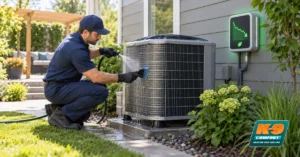
The outdoor condenser unit is where your system releases the heat it pulls from inside your home. If it can’t do that job, your house won’t cool down — no matter how hard the indoor equipment works.
Go outside and check:
- Is it running? You should hear and see the fan spinning.
- Is there ice on the refrigerant lines or coil? Ice is a sign of restricted airflow or low refrigerant — shut the system off and call a tech.
- Is debris blocking the coil? Grass clippings, cottonwood fluff, and leaves can pack tightly against the fins and reduce efficiency dramatically.
- Is it in direct sun with no clearance? The unit needs at least 2 feet of clearance on all sides and benefits from afternoon shade.
If the outdoor unit isn’t running at all while the indoor air handler is, that’s usually a capacitor, contactor, or refrigerant issue — all of which require a licensed technician.
5. Low Refrigerant
Refrigerant is the substance that actually moves heat out of your home. Your system doesn’t use up refrigerant like a car uses gas — if the level is low, it means there’s a leak somewhere in the system.
Signs of low refrigerant include:
- AC running constantly without cooling
- Ice forming on the refrigerant lines or indoor coil
- Hissing or bubbling sounds near the unit
- Higher-than-normal electric bills
Low refrigerant is not a DIY fix. Handling refrigerants requires EPA 608 certification, and adding refrigerant without finding and repairing the leak is just throwing money at a problem that will come back. Any reputable HVAC company will locate the leak first, repair it, and then recharge the system — in that order.
AC Running vs. AC Cooling: A Quick Comparison
| Symptom | Likely Cause | DIY Check? |
|---|---|---|
| AC runs, house doesn’t cool | Clogged filter, closed vents, low refrigerant | Partial |
| Warm air from vents | Low refrigerant, failed compressor | No — call a tech |
| AC cycles on/off rapidly | Oversized unit, refrigerant issue, dirty coil | No — call a tech |
| Ice on refrigerant lines | Restricted airflow or low refrigerant | Shut off, call a tech |
| No air from vents | Blower motor failure, duct issue | No — call a tech |
| AC won’t turn on at all | Thermostat, breaker, or capacitor | Check thermostat/breaker first |
What Most HVAC Companies Get Wrong
Here’s an honest truth: some HVAC companies show up, add refrigerant, collect a check, and leave. No leak search. No documentation. Just a band-aid on a problem that will cost you again in 6 months.
At K9 Comfort, we don’t guess. Every diagnostic visit includes actual system testing with documented results — pressures, temperatures, airflow readings — that we walk through with you before recommending anything. You’ll know exactly what’s wrong, why it matters, and what your options are. That’s not just a better customer experience. It’s the only honest way to do this work.
We’re not here to sell you something. We’re here to figure out what your system actually needs.
When to Call a Professional
You should call a licensed HVAC technician if:
- The outdoor unit isn’t running or is iced over
- There’s a hissing, bubbling, or clicking noise near the equipment
- Your electric bills have spiked without explanation
- The system runs constantly but can’t get below 80 degrees indoors
- Your AC is more than 12–15 years old and struggling to keep up
Systems older than 10–15 years are significantly less efficient than modern equipment — even when working. Sometimes the honest answer is that repair costs no longer make sense against replacement value.
For Marion, Delaware, Marysville, and the surrounding Central Ohio area, K9 Comfort offers straightforward AC repair services with no-surprise pricing. If your system needs a tune-up first, our AC maintenance program is designed to catch small problems before they become big ones. And if replacement is the right move, we’ll walk you through AC replacement options that fit your home, your budget, and your long-term goals.
An AC Not Cooling Your House Is a Problem Worth Solving the Right Way
When your AC isn’t cooling your house, start simple — thermostat, filter, vents, outdoor unit. Those four checks resolve a lot of problems without a service call. But if you’ve worked through the list and your home still won’t cool down, there’s something going on inside the system that needs trained eyes and proper testing equipment.
K9 Comfort was built on the belief that homeowners deserve honest information, not pressure. When you call us, you’ll get a documented diagnosis, clear options, and the space to make the right decision for your home.
FAQ
Why is my AC running but not blowing cold air?
The most common causes are a dirty air filter, low refrigerant, a frozen evaporator coil, or a failing compressor. Start by checking and replacing the air filter. If that doesn’t help, or if you see ice on the system, turn it off and call a licensed HVAC technician — running a frozen system can cause compressor damage.
Can I add refrigerant to my AC myself?
No. Handling refrigerants requires EPA 608 certification, and it’s illegal to do so without it. More importantly, low refrigerant always means there’s a leak somewhere — adding more without finding the leak is a temporary fix that won’t hold. A qualified technician will locate the leak, repair it, and then recharge the system properly.
How long does it take for an AC to cool a house?
On a typical Central Ohio summer day, a properly sized and functioning AC should reduce indoor temperature by about 1–2 degrees per hour under normal conditions. If your system has been off all day and it’s very hot outside, give it 2–3 hours. If it’s still struggling after that, something is wrong.
Why does my AC freeze up?
Ice on your AC is almost always caused by one of two things: restricted airflow (usually a clogged filter or blocked vents) or low refrigerant. Both prevent the evaporator coil from absorbing heat properly, causing moisture to freeze on the coil surface. If you see ice, turn the system to FAN-only mode to let it thaw, then check your filter. If the problem returns, call a technician.
Should I repair or replace my AC if it’s not cooling?
It depends on the age of the system, the cost of the repair, and the efficiency of the current unit. A general rule of thumb: if the repair cost exceeds 50% of the value of the system, or the unit is more than 12–15 years old, replacement often makes more financial sense. A trustworthy HVAC company will show you the numbers on both options and let you decide.
Ready to Get Your AC Cooling Again?
If you’ve worked through the checklist and your home still isn’t comfortable, don’t wait it out — Central Ohio summers don’t give much grace. The team at K9 Comfort Heating & Cooling is ready to help with an honest, no-pressure diagnostic visit. We’ll test your system, document the findings, and walk you through exactly what’s going on before any work begins.
Call us: (740) 361-7748
Schedule online: k9comfort.ai/contact-k9-comfort-in-marion
We serve Marion, Delaware, Marysville, Dublin, Lewis Center, Powell, Bucyrus, Upper Sandusky, Sunbury, and the surrounding Central Ohio area. Same family. Same standards. Every visit.
External References
- U.S. Department of Energy — Home Cooling Tips: https://www.energy.gov
- ENERGY STAR — Heating and Cooling: https://www.energystar.gov
- U.S. EPA — Refrigerant Management and Section 608 Regulations: https://www.epa.gov