A furnace that stops working in the middle of an Ohio winter isn’t just uncomfortable — it’s urgent. But a furnace that’s struggling quietly, running inefficiently, or behaving strangely can cost just as much over time without ever fully breaking down. K9 Comfort Heating & Cooling diagnoses and repairs furnaces across Marion, Marysville, Delaware, Powell, and the surrounding Central Ohio area — and we do it the same way every time: document what we find, explain what it means, and let you decide what happens next.
This guide covers the most common furnace repair problems Ohio homeowners face, what causes them, what the repair process should look like, and how to know when repair no longer makes financial sense. If your furnace is giving you trouble — or you just want to know what to expect before calling for service — start here.
Why Central Ohio Winters Put Furnaces to the Test
Ohio winters are genuinely demanding. Marion, Marysville, and the surrounding Central Ohio area regularly experience temperatures in the single digits and below zero during January and February. A furnace that coasts through mild winters can fail under that kind of sustained load.
Central Ohio also has a wide range of housing stock. Older homes near downtown Marion and Marysville were built with little insulation by today’s standards. They lose heat faster and demand more from their heating systems. Newer subdivisions are tighter and better insulated but come with their own variables — equipment that may have been sized or installed without proper load calculations, for example.
The result is that furnace problems in Central Ohio don’t always look the same from one home to the next. Diagnosis matters. Assumptions don’t.
Common Furnace Repair Problems in Central Ohio Homes
Most furnace repair calls fall into a recognizable set of categories. Here’s what each one looks and feels like — and what’s typically behind it.
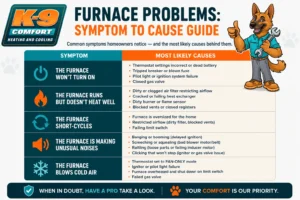
The Furnace Won’t Turn On
A furnace that won’t start at all usually points to one of a few causes. Work through these before calling for service.
- Thermostat settings — confirm the thermostat is set to HEAT, the temperature is set above the current room temperature, and the system is responding to adjustments. A dead thermostat battery causes a surprising number of no-start calls.
- Tripped breaker or blown fuse — check the electrical panel for a tripped breaker on the furnace circuit. Reset it once. If it trips again immediately, stop and call a technician — a repeatedly tripping breaker indicates an underlying electrical problem.
- Pilot light or ignition failure — older furnaces use a standing pilot light. Newer systems use electronic ignition. Both can fail. If the furnace attempts to start, you hear clicking, but nothing ignites, the ignitor or flame sensor is the likely culprit.
- Closed gas valve — confirm the gas supply valve on the line leading to the furnace is in the open position. This is occasionally closed accidentally during other work.
If none of these resolve the issue, a technician needs to diagnose further. Don’t attempt to force-start a furnace that’s clearly experiencing an ignition problem.
The Furnace Runs But Doesn’t Heat Well
This is one of the more common and frustrating furnace problems. The system runs, the blower moves air, but the house never reaches a comfortable temperature. Several things can cause this.
A dirty or clogged air filter is the first thing to check. A severely restricted filter reduces airflow across the heat exchanger dramatically. The furnace produces heat but can’t distribute it effectively. In extreme cases, restricted airflow causes the heat exchanger to overheat and the furnace to shut itself off on a safety limit.
A failing heat exchanger is a more serious cause. The heat exchanger is the component that separates combustion gases from the air your family breathes. Cracks in the heat exchanger allow combustion gases — including carbon monoxide — to enter the airstream. This is a safety issue, not just a performance issue. A furnace with a cracked heat exchanger should not be operated until it’s repaired or replaced.
A dirty burner or flame sensor also reduces heating performance. When the flame sensor accumulates buildup, it can’t confirm the burner has lit — so the furnace shuts off the gas as a safety precaution, even when combustion was occurring normally.
The Furnace Short-Cycles
Short-cycling means the furnace turns on, runs briefly, shuts off, and then repeats — never completing a full heating cycle. It’s inefficient, puts extra wear on components, and leaves the home feeling inconsistently heated.
Oversizing is a common cause. A furnace that’s too large for the home heats the space quickly, satisfies the thermostat, and shuts off — only to restart a few minutes later when the temperature drops. This pattern is built into an incorrectly sized system and doesn’t improve with repairs. It requires a proper load evaluation to address correctly.
Restricted airflow also causes short-cycling. A clogged filter, blocked vents, or closed registers prevent adequate airflow across the heat exchanger. The furnace overheats and trips a safety limit switch, shutting itself off before completing the cycle.
A failing limit switch itself can cause the same symptom — the switch trips prematurely even when temperatures are normal.
The Furnace Is Making Unusual Noises
Furnaces make recognizable sounds during normal operation — a click when the ignitor fires, a hum when the blower runs, and a whoosh when the burner lights. Sounds outside that pattern are worth paying attention to.
- Banging or booming — often delayed ignition. Gas accumulates before lighting and ignites with a small explosion. This stresses the heat exchanger and needs prompt attention.
- Screeching or squealing — usually a blower motor bearing failing or a worn belt on older belt-drive systems.
- Rattling — loose panels, debris in the blower, or a failing inducer motor.
- Clicking that doesn’t stop — the ignitor is attempting to fire but failing. The gas valve or ignitor likely needs attention.
Don’t run a furnace that’s banging, booming, or producing persistent ignition clicks without a service call. These symptoms can indicate problems that worsen quickly with continued operation.
The Furnace Blows Cold Air
A furnace blowing cold air through the vents is alarming — but the cause is often straightforward. The most common reasons include:
- The system is set to FAN-only mode on the thermostat rather than HEAT
- The pilot light or ignitor has failed and the blower is running without combustion
- The furnace overheated and shut off on its limit switch — the blower continues running to cool the heat exchanger even after the burner shuts down
- A failed gas valve is preventing fuel from reaching the burner
Each of these has a different fix. Diagnosis determines which one is actually happening before any parts are replaced.
What a Proper Furnace Diagnostic Looks Like
The difference between a good furnace repair and a frustrating one usually comes down to the quality of the diagnosis. Replacing parts based on symptoms alone — without measuring and testing — leads to misdiagnosis, unnecessary costs, and problems that return.
At K9 Comfort, every furnace diagnostic visit follows a documented process:
- System history and symptom review — age of equipment, prior repairs, how the problem is presenting, and any recent changes the homeowner has noticed
- Thermostat and controls verification — confirm the system is receiving correct signals before evaluating the equipment itself
- Visual inspection — heat exchanger, burner, ignitor, flame sensor, flue venting, filter, and blower condition
- Combustion analysis — gas pressure, flame quality, and burner operation measured against manufacturer specifications
- Electrical testing — voltage and amperage readings on the blower motor, inducer motor, and control board
- Airflow assessment — static pressure and temperature rise across the heat exchanger
- Safety device verification — limit switches, pressure switches, and rollout sensors all tested for proper operation
After completing that process, we present documented findings — specific readings, identified faults, and repair options with clear pricing. You see exactly what we found and exactly what we recommend before any work begins. Our heating services page covers the full range of furnace services we provide across Central Ohio.
Furnace Repair vs. Replacement: A Practical Framework
Not every furnace repair is worth making. When a system reaches a certain age or requires a significant investment, replacement often makes more financial sense. Here’s a straightforward framework for thinking it through.
| Scenario | Likely Right Move |
|---|---|
| Furnace under 10 years old, minor repair | Repair — system has significant life remaining |
| Furnace under 10 years old, heat exchanger failure | Evaluate carefully — get replacement quote to compare |
| Furnace 10–15 years old, minor repair | Repair, but begin planning for replacement |
| Furnace 10–15 years old, major repair | Replacement likely makes more financial sense |
| Furnace over 15 years old, any significant repair | Replacement is almost always the better investment |
| Repair cost exceeds 50% of system value | Replace regardless of age |
| Cracked heat exchanger at any age | Serious safety concern — replacement strongly recommended |
A few additional factors worth considering alongside age and repair cost:
- Efficiency gains — a furnace from 15 years ago may operate at 80% AFUE or lower. Modern high-efficiency systems operate at 96–98% AFUE. The monthly operating cost difference compounds quickly over Ohio’s long heating seasons.
- Repair frequency — a furnace that has needed multiple repairs in recent years is telling you something. Each repair on an aging system is borrowed time, not a long-term solution.
- Carbon monoxide risk — a cracked heat exchanger isn’t just an efficiency problem. It’s a safety issue. When repair of a compromised heat exchanger on an older system approaches the cost of replacement, replacement is the honest recommendation.
Preventive Maintenance: The Best Furnace Repair Is the One You Never Need
The majority of furnace breakdowns are preventable. Components wear gradually. A technician who inspects equipment regularly catches worn ignitors, dirty flame sensors, deteriorating heat exchangers, and failing capacitors before they become cold-night emergencies.
A professional furnace tune-up covers:
- Heat exchanger inspection for cracks or deterioration
- Burner cleaning and combustion analysis
- Ignitor and flame sensor cleaning or testing
- Blower motor inspection and lubrication
- Flue venting check for blockages or leaks
- Filter replacement
- Safety device testing — limit switches, pressure switches, rollout sensors
- Thermostat calibration
In Central Ohio, fall is the right time for furnace maintenance — before the first serious cold snap of the season. A system that’s been sitting unused since spring can develop problems over the summer that only show up when you first need it. Our heating maintenance page covers scheduled maintenance options across our service area.
FAQ
How much does furnace repair cost in Central Ohio?
Furnace repair costs vary based on the part involved and the complexity of the repair. Minor repairs — flame sensor cleaning, capacitor replacement, ignitor replacement — typically run in the $150–$400 range. More significant repairs involving the heat exchanger, control board, or inducer motor run higher. At K9 Comfort, we provide documented findings and clear pricing before any work begins — no surprises.
How long does a furnace repair take?
Most furnace repairs are completed in a single visit of one to three hours. Repairs requiring parts that need to be ordered may require a follow-up visit. At K9 Comfort, we carry commonly needed parts on our service vehicles to resolve the most frequent issues same-day.
Is it safe to run my furnace if it’s making a banging noise?
No. A banging or booming sound from a furnace most commonly indicates delayed ignition — gas accumulates before lighting and ignites with force. This puts significant stress on the heat exchanger and can cause cracks over time. Turn the system off and call for service. Don’t continue operating a furnace with this symptom.
What causes a furnace to short-cycle?
Short-cycling — the furnace turning on and off rapidly without completing a full heating cycle — most commonly results from a clogged air filter, blocked vents, an oversized system, or a failing limit switch. A dirty filter is the first thing to check and replace. If the problem continues after replacing the filter, a service call is warranted.
How do I know if my furnace has a cracked heat exchanger?
Signs of a cracked heat exchanger include a carbon monoxide alarm triggering, visible soot around the furnace, headaches or dizziness that improve when you leave the home, and a flame that flickers or moves when the blower turns on. A cracked heat exchanger is a carbon monoxide risk. If you suspect one, turn off the furnace and call for service immediately.
Furnace Not Working Right? Let’s Find Out Why.
A furnace problem that gets ignored doesn’t improve on its own — and Ohio winters don’t allow much grace period. The right repair starts with the right diagnosis, and that’s exactly what K9 Comfort Heating & Cooling delivers on every service call across Central Ohio. We document what we find, walk you through the options, and let you decide — no pressure, no guesswork, no surprises.
Call us: (740) 361-7748
Schedule online: k9comfort.ai/contact-k9-comfort-in-marion
We serve Marion, Marysville, Delaware, Dublin, Lewis Center, Powell, Bucyrus, Upper Sandusky, Sunbury, and the surrounding Central Ohio area. Same family. Same standards. Every visit.

External References
- U.S. Department of Energy — Home Heating Systems: https://www.energy.gov
- ENERGY STAR — Furnaces and Heating Equipment: https://www.energystar.gov
- Carrier — Furnace Repair and Maintenance: https://www.carrier.com
- Lennox — Furnace Products and Service: https://www.lennox.com
- Trane — Heating Systems and Repair: https://www.trane.com