Most Marion homeowners don’t think about their furnace until it stops working. That’s understandable — when things are running smoothly, there’s no reason to. But a furnace that hasn’t been professionally serviced in a year or more is a furnace running on borrowed time, particularly heading into a Central Ohio winter. K9 Comfort Heating & Cooling provides thorough, documented furnace tune-ups across Marion, Marysville, Delaware, Powell, and the surrounding Central Ohio area — and fall is the best possible time to schedule one.
This guide covers exactly what a professional furnace tune-up includes, why each step matters, and what separates a genuine maintenance visit from a quick once-over that leaves problems behind.
Why Fall Is the Right Time for a Furnace Tune-Up in Marion, Ohio
Timing matters more than most homeowners realize. A furnace tune-up in September or October accomplishes something a March tune-up can’t — it identifies problems before you need the system, not after it’s already failed.
Central Ohio winters arrive fast and stay. Marion and the surrounding area regularly see temperatures drop into the single digits by January. A furnace that coasted through a mild fall can fail completely when sustained cold weather arrives and load increases. The first cold night of the season is the worst possible time to discover a cracked heat exchanger, a failing ignitor, or a blower motor that’s on its last legs.
Fall scheduling also means shorter wait times. HVAC companies across Central Ohio are busiest during emergency calls in December and January. Scheduling a tune-up in October means you get a thorough, unhurried service visit — not a technician rushing between breakdowns.
What a K9 Comfort Furnace Tune-Up Includes
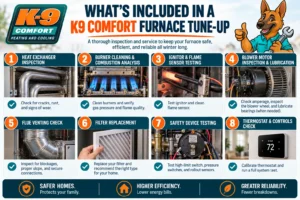
A genuine furnace tune-up is a systematic inspection and service visit — not a filter swap and a signature on a form. Here’s what a thorough tune-up covers and why each item matters.
Heat Exchanger Inspection
The heat exchanger is the most critical component in your furnace. It separates combustion gases — including carbon monoxide — from the air your family breathes. Cracks in the heat exchanger allow those gases to enter the airstream and circulate through the home.
Visual inspection of the heat exchanger is a standard part of every K9 Comfort tune-up. We look for cracks, holes, rust, and signs of deterioration. A compromised heat exchanger is a safety issue, not just an efficiency issue — and it’s one of the main reasons annual professional inspection matters regardless of how well the system appears to be running.
Burner Cleaning and Combustion Analysis
Furnace burners accumulate dust, oxidation, and debris over time. Dirty burners produce incomplete combustion — a less efficient burn that wastes fuel and can produce elevated carbon monoxide levels.
During a tune-up, burners are cleaned and inspected for proper flame pattern. Combustion analysis measures gas pressure and flame quality against manufacturer specifications. A furnace that passes combustion analysis is burning cleanly and efficiently. One that doesn’t needs attention before heating season begins.
Ignitor and Flame Sensor Testing
The ignitor lights the burner. The flame sensor confirms the burner has lit and keeps the gas valve open. Both are small components that fail at high rates on aging systems — and both cause a complete furnace shutdown when they do.
During a tune-up, the ignitor is tested for proper resistance and inspected for cracks or wear. The flame sensor is cleaned of any buildup that causes it to misread the flame. Addressing these components proactively costs a fraction of an emergency service call in January.
Blower Motor Inspection and Lubrication
The blower motor pushes conditioned air through your ductwork to every room in the house. A motor that’s running hot, drawing too much current, or failing to produce adequate airflow reduces heating efficiency and can cause the furnace to overheat and trip its safety limit switch.
Blower motor inspection includes checking amperage draw against rated specifications, inspecting the blower wheel for debris accumulation, and lubricating motor bearings on systems that require it. A blower motor that’s trending toward failure can often be identified at a tune-up — well before it fails completely.
Flue Venting Check
The flue system carries combustion gases safely out of the home. Blockages, disconnected joints, or improper slope can allow carbon monoxide to back-draft into the living space rather than exhaust outdoors.
A venting inspection checks the flue pipe for obstructions — bird nests, debris, and corrosion are common — and confirms all joints are properly connected and sealed. This is a quick check that carries significant safety implications.
Filter Replacement
A clean filter is the single most impactful maintenance task a homeowner can perform between professional visits. A severely clogged filter restricts airflow across the heat exchanger, causes the furnace to overheat, and can trigger safety shutdowns.
Filter replacement is included in every K9 Comfort tune-up. We’ll also advise on the right filter type and replacement frequency for your specific system — because the right answer varies based on system design and household conditions.
Safety Device Testing
Modern furnaces include multiple safety devices designed to shut the system down before a dangerous condition develops. These include the high-limit switch, pressure switches, and rollout sensors.
Each of these devices is tested during a tune-up to confirm it activates correctly at the appropriate threshold. A safety device that’s failed in the open position — meaning it never trips — provides no protection when a real fault occurs. Testing confirms the safety systems are actually doing their job.
Thermostat Calibration and Controls Check
The tune-up closes with a thermostat calibration and full operational test. The system runs through a complete heating cycle while we verify that all components respond correctly to thermostat signals, that the blower operates at proper speed, and that the system shuts down cleanly at the end of a cycle.
This final step catches integration issues — problems between components that work individually but don’t function correctly together — that a component-by-component inspection might miss.
What K9 Comfort Does Differently
Most furnace tune-ups end with a technician handing you a completed form and telling you everything looks fine. You have no way to verify that — and no documentation to reference if something goes wrong later.
At K9 Comfort, every tune-up produces documented findings. We record actual measurements — combustion readings, motor amperage, pressure switch operation — and we walk you through what we found before we leave. If we identify a component trending toward failure, we show you the data that supports that finding and present your options clearly. You decide what happens next.
That’s not just a better customer experience. It’s the only honest way to deliver maintenance that actually protects your investment. Our heating services page covers the full range of furnace maintenance and repair services we provide across Central Ohio.

How Often Should You Schedule a Furnace Tune-Up?
Once per year is the standard recommendation — and fall is the right time to do it. A furnace that runs through a full Ohio heating season accumulates wear on burners, sensors, and mechanical components. Annual maintenance resets that baseline and catches developing problems before they become failures.
Some situations call for more frequent attention:
- Furnaces over 15 years old benefit from twice-yearly inspection as components approach end of life
- Homes with pets or high dust levels may need more frequent filter changes and blower cleaning
- Rental properties or homes that have sat vacant should be inspected before the first use of the season
The cost of an annual tune-up is a fraction of the cost of an emergency repair call — and a small fraction of the cost of premature equipment replacement caused by deferred maintenance.
Furnace Tune-Up vs. Furnace Repair: Understanding the Difference
A tune-up is scheduled, preventive, and performed on a system that’s currently working. A repair is reactive — it addresses a failure that’s already occurred. The goal of a tune-up is to prevent repairs.
| Tune-Up | Repair | |
|---|---|---|
| When | Before a problem occurs | After something fails |
| Purpose | Prevent failures, optimize performance | Fix a specific fault |
| Cost | Predictable, lower | Variable, often higher |
| Timing | Fall, before heating season | When the system stops working |
| Scheduling | Planned in advance | Often urgent or emergency |
| Outcome | Peace of mind heading into winter | Restored function |
The two aren’t mutually exclusive. A tune-up sometimes uncovers a component that needs repair — a worn ignitor, a weak capacitor, a heat exchanger showing early signs of cracking. Identifying those issues at a tune-up means addressing them on your schedule, at standard pricing, rather than as an emergency on the coldest night of the year.
What Happens If You Skip the Annual Tune-Up?
A furnace that runs without annual maintenance doesn’t fail immediately. It degrades gradually — efficiency drops, components wear, and small problems compound into larger ones. Here’s what deferred maintenance typically produces over time:
- Higher energy bills — dirty burners and restricted airflow mean the system works harder and uses more fuel to deliver the same amount of heat
- More frequent repairs — worn components fail without warning, often at the worst possible time
- Shorter equipment lifespan — a furnace that receives annual maintenance regularly reaches 15–20 years; one that doesn’t often fails at 10–12
- Voided manufacturer warranties — many furnace warranties require documented annual maintenance as a condition of coverage
- Safety risks — a cracked heat exchanger or failed safety device that annual inspection would have caught
The math consistently favors preventive maintenance. Annual tune-ups don’t just keep the furnace running — they protect the investment the furnace represents.
Signs Your Furnace Is Overdue for a Tune-Up
If any of the following apply, schedule a tune-up before the heating season is in full swing:
- You can’t remember the last time a technician looked at your furnace
- Your energy bills were higher than expected last winter
- The furnace made new noises last season that you attributed to normal aging
- The system took longer than usual to heat the house on cold days
- You’ve had any repair work done in the last two years without a full inspection following it
- The furnace is more than 10 years old and has never had a professional tune-up
Any one of these is a sufficient reason to schedule a visit before temperatures drop. All of them together make it urgent.
Why Marion Homeowners Trust K9 Comfort for Furnace Tune-Ups
K9 Comfort serves Marion and the surrounding Central Ohio area with a diagnostic-first approach that’s different from what most HVAC companies offer. Every tune-up visit includes documented measurements, a clear summary of findings, and honest recommendations — never a pressure to purchase services you don’t need.
We understand Marion’s housing stock. We know the difference between a 1970s ranch in need of careful heat exchanger inspection and a newer build with different equipment demands. We bring that local knowledge to every visit. Learn more about our furnace maintenance services on our furnace maintenance service page.
We serve Marion, Marysville, Delaware, Dublin, Lewis Center, Powell, Bucyrus, Upper Sandusky, Sunbury, and the surrounding Central Ohio area.

FAQ
How long does a furnace tune-up take?
A thorough furnace tune-up typically takes 60–90 minutes. That time covers the full inspection, cleaning, testing, and documentation process. Any visit significantly shorter than that is unlikely to cover everything a proper tune-up requires.
How much does a furnace tune-up cost in Marion, Ohio?
Furnace tune-up costs in the Marion area typically range from $80–$150 depending on the service provider and what’s included. At K9 Comfort, the visit includes documented findings and a clear summary of the system’s condition — not just a completed checklist.
Can I do a furnace tune-up myself?
Homeowners can handle filter replacement and basic visual checks. However, combustion analysis, heat exchanger inspection, electrical component testing, and safety device verification require specialized tools and training. Attempting these without proper equipment can miss critical problems — or create new ones. Annual professional service is worth the investment.
What is the difference between a furnace tune-up and a furnace inspection?
The terms are often used interchangeably, but a tune-up implies active servicing — cleaning burners, lubricating components, replacing the filter — in addition to inspection. An inspection alone is an evaluation without hands-on maintenance. A K9 Comfort tune-up includes both.
Will a furnace tune-up reduce my heating bills?
Yes — often meaningfully. A furnace running with dirty burners, restricted airflow, or worn components uses more fuel to produce the same amount of heat. Cleaning and servicing those components restores efficiency. Homeowners with older, unmaintained systems sometimes see noticeable reductions in monthly heating costs after a thorough tune-up.
Don’t Wait Until the First Cold Night to Find Out Your Furnace Isn’t Ready
The best furnace tune-up is the one scheduled before you need heat, not after the system fails. K9 Comfort Heating & Cooling is scheduling fall furnace tune-ups across Marion and Central Ohio now — with honest, documented service and no pressure to purchase anything your system doesn’t actually need.
Call us: (740) 361-7748
Schedule online: k9comfort.ai/contact-k9-comfort-in-marion
We serve Marion, Marysville, Delaware, Dublin, Lewis Center, Powell, Bucyrus, Upper Sandusky, Sunbury, and the surrounding Central Ohio area. Same family. Same standards. Every visit.
External References
- U.S. Department of Energy — Furnace Efficiency and Maintenance: https://www.energy.gov
- ENERGY STAR — Heating and Cooling Maintenance: https://www.energystar.gov
- Carrier — Furnace Maintenance Tips: https://www.carrier.com
- Lennox — Furnace Products and Service: https://www.lennox.com
- Trane — Heating Systems: https://www.trane.com