A heat pump that stops heating in the middle of an Ohio winter is one of the most stressful home problems a homeowner can face. What makes it particularly confusing is that the system often appears to be running — the unit outside is humming, the air handler is blowing — but the house just won’t warm up. K9 Comfort Heating & Cooling works with homeowners across Marion, Marysville, Delaware, Powell, and Central Ohio to diagnose heat pump heating failures accurately and fix them the right way — with documented findings before any work begins.
This guide covers the most common reasons a heat pump stops heating, what each one looks and feels like, and what to do about it. Some causes are simple enough to check yourself. Others require a licensed technician. Knowing the difference saves time, money, and a very cold night.
How a Heat Pump Heats — And Why Ohio Winters Test It
Before troubleshooting, it helps to understand what a heat pump is actually doing. Unlike a furnace, a heat pump doesn’t generate heat. Instead, it extracts heat energy from outdoor air and transfers it inside. In summer, that process reverses — the system pulls heat from inside your home and releases it outdoors, working like a central air conditioner.
That refrigeration cycle runs in both directions. In winter, the system’s efficiency depends on its ability to extract heat from cold outdoor air. As temperatures drop, that becomes harder — and components that are worn or marginal during moderate weather often fail under the sustained load of a Central Ohio winter.
This is why heat pump heating problems tend to surface when you need the system most. A component that coasted through mild fall weather may fail during the first serious cold snap of the season.
Start Here: Simple Checks Before Calling a Technician
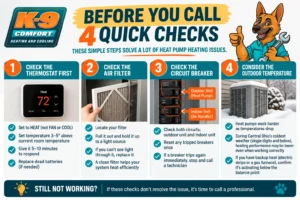
Before assuming a mechanical problem, work through these checks. They resolve a meaningful percentage of heat pump heating calls without a service visit.
Check the thermostat first.
Confirm it’s set to HEAT — not FAN or COOL. Set the temperature at least 3–5 degrees above the current room temperature and give the system 5–10 minutes to respond. If the thermostat has dead batteries, it may display normally but fail to communicate with the system. Replace the batteries and try again.
Check the air filter.
A severely clogged filter restricts airflow so dramatically that the system can’t distribute heat effectively even when it’s producing it. Locate your filter, pull it out, and hold it up to a light source. If you can’t see light through it, replace it before calling anyone.
Check the circuit breaker.
A heat pump has two electrical circuits — one for the outdoor unit and one for the indoor air handler. Both need to be on. Check the breaker panel and reset any tripped breakers once. If a breaker trips again immediately, stop and call a technician — a repeatedly tripping breaker signals an underlying electrical problem.
Give it time if outdoor temperatures are extreme.
Heat pumps work harder as temperatures drop. During Central Ohio’s coldest stretches — single digits and below — a heat pump may struggle to maintain indoor temperature even when functioning correctly. If your system has a backup heat source (electric strips or a gas furnace in a dual-fuel setup), confirm it’s activating when outdoor temperatures drop below the balance point.
Common Reasons a Heat Pump Stops Heating
If the simple checks don’t resolve the issue, one of the following is almost certainly the cause.
The Reversing Valve Is Stuck or Failing
The reversing valve is the component that switches the heat pump between heating and cooling mode. When it sticks or fails, the system may run continuously in cooling mode — actively removing heat from your home instead of adding it. This is one of the most common heat pump heating failures and one of the most frequently misdiagnosed.
Signs of a stuck reversing valve include a system that blows noticeably cool or lukewarm air in heating mode, an indoor temperature that drops despite the system running, and a system that worked fine for cooling in summer but fails to heat in fall.
A reversing valve failure requires a licensed technician to diagnose and repair. The valve itself is replaceable, though on older systems the repair cost relative to the system’s value is worth evaluating honestly.
The System Is Low on Refrigerant
Refrigerant is the substance that moves heat from one place to another. A heat pump low on refrigerant loses its ability to extract and transfer heat effectively — the system runs constantly but can’t deliver adequate warmth regardless of outdoor temperature.
Low refrigerant always means there’s a leak somewhere in the system. Adding more without finding and repairing the leak is a temporary fix that will fail again. A licensed technician locates the leak, repairs it, then recharges the system to manufacturer specifications — in that order.
Signs of low refrigerant include the system running continuously without reaching set temperature, ice forming on the refrigerant lines or outdoor coil, and a hissing or bubbling sound near the unit.
The Outdoor Coil Is Iced Over
Some frost on the outdoor unit during cold weather is completely normal. Heat pumps have a built-in defrost cycle that periodically reverses operation briefly to clear ice from the outdoor coil. You may notice steam rising from the outdoor unit during defrost — that’s normal.
A problem exists when the outdoor coil ices over completely and doesn’t clear, or when the unit is encased in ice rather than a thin layer of frost. A fully iced coil can’t extract heat from outdoor air — the system runs but produces little to no heat.
Causes of excessive icing include low refrigerant, a malfunctioning defrost control board, a failed defrost sensor, or restricted airflow from a dirty coil or blocked unit. If you see a fully iced outdoor unit, turn the system to FAN-only mode to allow it to thaw, then call for service.
Do not pour hot water on a frozen unit. Allow it to thaw naturally with the system off or in FAN mode.
A Capacitor or Contactor Has Failed
The capacitor starts the compressor and fan motors. When it fails, the outdoor unit may attempt to start, hum briefly, and then shut off — or it may not start at all. A failed capacitor is one of the most common and relatively straightforward heat pump repairs.
The contactor is an electrical switch that allows power to reach the outdoor unit from the thermostat. When it burns out or sticks open, the outdoor unit won’t run even if the indoor air handler is operating normally.
Both components are diagnosable with basic electrical testing. Neither is a DIY repair — capacitors store electrical charge even when power is off and are dangerous to handle without proper training.
The Defrost Control Board Is Failing
The defrost control board manages the timing and duration of defrost cycles. When it fails, the system either defrosts too frequently — reducing heating capacity — or not at all, allowing ice to accumulate on the outdoor coil unchecked.
A failing defrost board often shows up as inconsistent heating — the system heats adequately sometimes but fails during extended cold periods. This is a less obvious failure mode that requires a systematic diagnostic process to identify correctly.
The System Is Undersized for the Home or the Climate
This is less a repair problem and more a design problem — but it’s worth understanding. A heat pump that was incorrectly sized when installed may have performed adequately during mild winters but simply lacks the capacity to heat the home during Central Ohio’s coldest stretches.
Signs of an undersized system include a heat pump that runs continuously without ever reaching set temperature on cold days, supplemental heat that runs constantly alongside the heat pump, and consistently higher-than-expected heating bills.
If you’ve had repeated service calls with no definitive mechanical cause identified, incorrect sizing may be contributing. A proper Manual J load calculation — the industry-standard method for determining the right equipment size — is the only accurate way to evaluate this.

Heat Pump Heating Problems in Cold Weather: What’s Normal vs. What Isn’t
Central Ohio homeowners with heat pumps sometimes worry their system is failing when it’s actually operating within normal parameters. Here’s a clear breakdown.
| Situation | Normal or Problem? |
|---|---|
| Outdoor unit running with light frost on coil | Normal |
| Steam rising from outdoor unit briefly | Normal — defrost cycle |
| System blows slightly cooler air than a furnace | Normal — heat pumps deliver 90–100°F air vs. furnace 120–140°F |
| System runs longer cycles in cold weather | Normal — heat pumps work harder below 35°F |
| System runs continuously below 20°F | Normal if backup heat is supplementing |
| Outdoor unit completely encased in ice | Problem — call for service |
| System blows cold air for more than 15 minutes | Problem — not defrost cycle |
| System runs but indoor temperature is dropping | Problem — call for service |
| Outdoor unit not running while indoor unit is | Problem — electrical or mechanical failure |
| Hissing or bubbling near unit | Problem — possible refrigerant leak |
What a Proper Diagnostic Looks Like
Here’s something worth knowing before you call any HVAC company: the quality of the diagnosis determines the quality of the repair. Replacing parts based on symptoms alone — without measuring and testing — leads to misdiagnosis, unnecessary costs, and problems that return.
At K9 Comfort, every heat pump diagnostic visit follows a documented process. We check thermostat and controls first, then measure electrical components — voltage, amperage, and capacitor readings. We check refrigerant pressures against manufacturer specifications for current outdoor temperature. We assess airflow, inspect the coil, and test the reversing valve and defrost controls in both heating and cooling mode.
After completing that process, we present you with documented findings and clear options before any work begins. You know exactly what’s wrong, why it matters, and what your choices are. That’s how honest HVAC service works. Our heat pump services page covers the full range of repair and maintenance options we offer across Central Ohio.
When to Repair vs. When to Replace
Not every heat pump heating failure is worth repairing. When a system reaches a certain age or requires a significant repair, replacement often makes more financial sense. Here’s a practical starting point.
- System under 10 years old, minor repair: Repair — significant useful life remaining
- System under 10 years old, compressor failure: Evaluate carefully — get a replacement quote to compare
- System 10–15 years old, minor repair: Repair, but begin planning for replacement
- System 10–15 years old, major repair: Replacement likely makes more financial sense
- System over 15 years old, any significant repair: Replacement is almost always the better investment
- Repair cost exceeds 50% of system value: Replace regardless of age
One additional factor worth noting for Central Ohio homeowners: if your heat pump uses R-22 refrigerant — common in systems installed before 2010 — replacement becomes a stronger argument even for moderate repairs. R-22 production ended in 2020 and the remaining supply is expensive and increasingly limited.
Our heating services page covers furnace and heat pump replacement options if the repair conversation leads in that direction.

FAQ
Why does my heat pump blow lukewarm air instead of hot air?
Heat pumps deliver air at 90–100°F, which is noticeably cooler than the 120–140°F air a gas furnace produces. That’s normal — the system runs longer cycles but delivers consistent heat across the home. If the air feels cold rather than warm, or if your home temperature is dropping despite the system running, that’s a problem worth investigating.
My heat pump worked fine all summer. Why isn’t it heating now?
The reversing valve switches the system between heating and cooling mode. If it sticks or fails, the system may have cooled your home perfectly all summer but can’t switch into heating mode for fall. This is one of the most common reasons a heat pump that performed well in summer fails to heat in winter.
Should I run my heat pump below 0 degrees Fahrenheit?
Modern cold-climate heat pumps are designed to operate down to 0°F or below. Older systems may lose efficiency rapidly below 25–30°F. If your heat pump has a backup heat source — electric strips or a gas furnace in a dual-fuel system — that backup should activate automatically when outdoor temperatures drop below the system’s balance point. If it isn’t, your thermostat or backup heat settings may need adjustment.
How do I know if my outdoor heat pump unit is frozen vs. just frosted?
Normal frost is a thin white coating on the coil fins that clears during a defrost cycle. A frozen unit has thick ice accumulation — often covering the coil completely or forming around the base and sides of the unit. If your unit doesn’t clear after a defrost cycle or stays heavily iced for more than an hour, turn the system off and call for service.
Can I run a space heater while I wait for heat pump repair?
Yes — space heaters are a reasonable short-term solution while waiting for service. Use them carefully: keep them away from flammable materials, never leave them unattended, and plug them directly into wall outlets rather than extension cords. They’re a bridge, not a solution, but they’ll keep your family comfortable until the system is repaired.
Heat Pump Not Heating? Let’s Find Out Why.
A heat pump that isn’t heating in Central Ohio winter isn’t something to wait on. The right fix starts with the right diagnosis — and that’s exactly what K9 Comfort Heating & Cooling delivers on every service call. We document what we find, walk you through the options, and let you decide — no pressure, no guesswork, no surprises.
Call us: (740) 361-7748
Schedule online: k9comfort.ai/contact-k9-comfort-in-marion
We serve Marion, Marysville, Delaware, Dublin, Lewis Center, Powell, Bucyrus, Upper Sandusky, Sunbury, and the surrounding Central Ohio area. Same family. Same standards. Every visit.
External References
- U.S. Department of Energy — Heat Pump Systems: https://www.energy.gov
- ENERGY STAR — Heat Pumps: https://www.energystar.gov
- Carrier — Heat Pump Troubleshooting: https://www.carrier.com
- Lennox — Heat Pump Products and Service: https://www.lennox.com
- Trane — Heat Pump Systems: https://www.trane.com