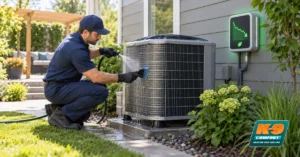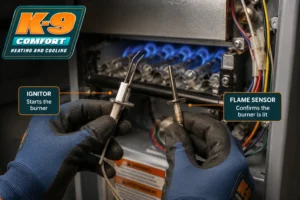
A heat pump that stops heating — or stops cooling — in the middle of an Ohio season is more than an inconvenience. It’s a problem that needs the right diagnosis before it gets the right fix. K9 Comfort Heating & Cooling works with Central Ohio homeowners across Marion, Marysville, Delaware, Powell, and the surrounding area to diagnose heat pump problems accurately and repair them the honest way — with documented findings and clear options before any work begins.
This guide covers the most common heat pump problems Ohio homeowners experience, what causes them, what the repair process should look like, and how to know when repair no longer makes financial sense. Whether your system stopped working suddenly or has been struggling for a while, this is where to start.
How Heat Pumps Work — And Why Ohio’s Climate Tests Them
Understanding a heat pump starts with one key distinction. A heat pump doesn’t generate heat — it moves it. In winter, it pulls heat energy from outdoor air and transfers it inside. In summer, it reverses that process and works like a central air conditioner.
That refrigeration cycle runs year-round, in both directions. As a result, heat pumps accumulate operating hours faster than a system that only heats or only cools. More run time means more wear on components — and more opportunities for something to go wrong.
Ohio’s climate adds specific pressure. Central Ohio winters push heat pumps harder than milder climates. When temperatures drop into the single digits, a heat pump works at or near its capacity limit. Components that are worn or marginal during moderate weather often fail during cold snaps. That’s why heat pump problems in Central Ohio tend to surface during the most inconvenient times of year.
Common Heat Pump Problems in Central Ohio Homes
Most heat pump repair calls fall into a recognizable set of categories. Here’s what each one looks and sounds like — and what’s typically behind it.
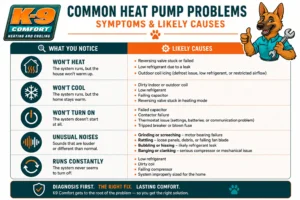
The Heat Pump Won’t Heat
This is the most common winter complaint. The system runs, but the house won’t warm up. Several things can cause this.
The reversing valve is the component that switches the heat pump between heating and cooling mode. When it fails or sticks, the system may run in the wrong direction — cooling the house when it should be heating it. A stuck reversing valve requires a technician to diagnose and replace.
Low refrigerant is another common cause. A heat pump low on refrigerant loses its ability to move heat efficiently. The system runs constantly but can’t deliver adequate warmth. Low refrigerant always indicates a leak somewhere in the system — adding more without finding and repairing the leak is a temporary fix that will fail again.
Outdoor coil icing is also worth checking. Some frost on the outdoor unit during cold weather is normal — heat pumps have a defrost cycle to manage it. However, a coil that ices over completely and doesn’t clear points to a defrost control problem, low refrigerant, or restricted airflow.
The Heat Pump Won’t Cool
In summer, the most common complaint is a heat pump running without adequately cooling the home. This mirrors many of the same causes as AC not cooling — dirty coils, low refrigerant, a failing capacitor, or a reversing valve stuck in heating mode.
A dirty indoor or outdoor coil reduces the system’s ability to transfer heat effectively. Coils accumulate dust, debris, and in outdoor units, grass clippings and cottonwood in Ohio summers. Regular maintenance prevents this — but when it’s already an issue, a professional coil cleaning restores meaningful efficiency.
The Heat Pump Won’t Turn On
A system that won’t start at all usually points to an electrical issue. Capacitors start the compressor and fan motors — when a capacitor fails, the system tries to start, hums, and then shuts off. Capacitors are a common, relatively inexpensive repair.
Contactor failure is another possibility. The contactor is an electrical switch that allows power to reach the outdoor unit. When it burns out or sticks, the outdoor unit won’t run even if the indoor air handler is operating. Both capacitors and contactors are diagnosable quickly with the right equipment.
Thermostat issues also cause no-start problems. Before calling for service, confirm the thermostat is set correctly, the batteries are fresh, and the system is responding to setting changes. A thermostat that’s lost communication with the heat pump can look like a serious mechanical failure when the fix is straightforward.
The Heat Pump Is Making Unusual Noises
Heat pumps make a range of normal sounds — a low hum during operation, a click when starting and stopping, and a whooshing sound during the defrost cycle. Sounds outside that range are worth paying attention to.
- Grinding or screeching — usually a motor bearing failing in the fan or compressor
- Rattling — often loose panels, debris in the outdoor unit, or a failing fan blade
- Bubbling or hissing — frequently indicates a refrigerant leak
- Banging or clanking — a more serious mechanical issue, often in the compressor
Don’t run a heat pump that’s making grinding, banging, or hissing sounds. Continuing to operate a system with these symptoms can turn a repairable problem into a compressor failure — which is the most expensive component in the system.
The Heat Pump Is Running Constantly
A heat pump that never cycles off is working harder than it should. During extreme cold, this can be normal — heat pumps run longer in severe weather because they’re extracting heat from very cold air. However, a system that runs continuously during moderate temperatures points to a problem.
Low refrigerant, a dirty coil, a failing compressor, or a system that was never sized correctly for the home can all cause constant running. Each requires a different fix, which is why diagnosis comes before any repair recommendation.
What a Proper Heat Pump Diagnostic Looks Like
Here’s a reality of the HVAC industry: some technicians show up, observe the symptom, and replace a part based on experience and intuition. Sometimes that’s right. Sometimes it isn’t — and the homeowner pays for a part that didn’t fix the problem.
A proper heat pump diagnostic is more systematic than that. At K9 Comfort, every diagnostic visit follows a documented process:
- System history review — age of equipment, prior repairs, and any changes in performance the homeowner has noticed
- Thermostat and controls check — confirm the system is receiving correct signals before looking at equipment
- Electrical measurements — voltage, amperage, and capacitor readings on all major components
- Refrigerant pressure check — suction and discharge pressures compared against manufacturer specifications for current outdoor temperature
- Airflow assessment — static pressure, filter condition, and coil cleanliness
- Operational test — run the system in both heating and cooling mode and document performance
After completing that process, we present you with documented findings — specific readings, identified faults, and repair options with clear pricing. You see exactly what we found and exactly what we recommend before any work begins. That’s not just a better customer experience. It’s the only way to be confident the right problem is being fixed.
Heat Pump Repair vs. Replacement: How to Think About It
Not every heat pump repair is worth making. When a system reaches a certain age or requires a significant repair, replacement often makes more financial sense. Here’s a practical framework for thinking it through.
| Scenario | Likely Right Move |
|---|---|
| System under 10 years old, minor repair | Repair — system has significant life remaining |
| System under 10 years old, major repair (compressor) | Evaluate carefully — get replacement quote to compare |
| System 10–15 years old, minor repair | Repair, but begin planning for replacement |
| System 10–15 years old, major repair | Replacement likely makes more financial sense |
| System over 15 years old, any significant repair | Replacement is almost always the better investment |
| Repair cost exceeds 50% of system value | Replace regardless of age |
A few additional factors worth considering alongside age and repair cost:
- Refrigerant type — older systems using R-22 refrigerant face limited and expensive refrigerant supply. R-22 was phased out of production and replacement refrigerant is costly. If your system uses R-22 and needs a refrigerant recharge, replacement becomes a much stronger financial argument.
- Efficiency gains — a heat pump from 10–15 years ago operates at a significantly lower efficiency rating than today’s equipment. The monthly operating cost difference may offset a replacement investment faster than you’d expect.
- Federal tax credits — qualifying heat pump replacements are eligible for a federal tax credit of up to 30% of the cost under the Inflation Reduction Act. That credit meaningfully changes the replacement math for many homeowners.
At K9 Comfort, we’ll present you with honest numbers on both options. If repair makes more sense, we’ll say so. If replacement is the better long-term investment, we’ll show you why. You make the call with full information in front of you. Our heat pump services page covers the full range of repair and replacement options we offer across Central Ohio.
Preventive Maintenance: The Best Heat Pump Repair Is the One You Never Need
Most heat pump problems don’t appear without warning. They develop gradually — and regular maintenance catches them before they become failures.
A professional heat pump tune-up covers the components most likely to cause problems:
- Coil cleaning — indoor and outdoor
- Refrigerant pressure check
- Electrical component inspection — capacitors, contactors, wiring
- Thermostat calibration and controls check
- Filter replacement
- Defrost cycle verification
- Airflow measurement
In Central Ohio, we recommend heat pump maintenance twice a year — once in spring before cooling season and once in fall before heating season. A system that receives consistent maintenance runs more efficiently, lasts longer, and fails less often. Our AC maintenance services page covers what a full preventive visit includes.
FAQ
How do I know if my heat pump needs repair or just maintenance?
If your system is running but underperforming — struggling to heat or cool, running longer than usual, or making new sounds — it likely needs a diagnostic visit. If it’s completely stopped working, repair is almost certainly needed. Regular maintenance prevents many of these situations by catching worn components before they fail entirely.
Can I add refrigerant to my heat pump myself?
No. Handling refrigerants requires EPA 608 certification, and it’s illegal to do so without it. More importantly, low refrigerant always means there’s a leak in the system. Adding refrigerant without finding and repairing the leak is a temporary measure that will fail again. A certified technician locates the leak, repairs it, and then recharges the system properly.
Why does my heat pump blow cold air in heating mode?
A heat pump blowing cool air in heating mode most commonly points to a stuck reversing valve, low refrigerant, or a system operating in defrost mode. Defrost mode is normal and temporary — the system briefly reverses to clear ice from the outdoor coil. If cool air continues for more than 10–15 minutes, it’s worth a service call.
My heat pump works fine in summer but struggles in winter — is that normal?
Heat pumps work harder in cold weather because they’re extracting heat from cold outdoor air. Some reduction in performance during Ohio’s coldest stretches is expected. However, a system that can’t maintain indoor temperature during moderate winter weather — above 25–30 degrees — is likely experiencing a mechanical issue rather than a climate limitation.
How long do heat pumps typically last in Central Ohio?
Well-maintained heat pumps typically last 15–20 years in Central Ohio. Systems that run without regular maintenance, were incorrectly sized, or experienced unresolved refrigerant leaks tend to fail earlier. Annual or twice-yearly maintenance is the most reliable way to reach the upper end of that range.
Heat Pump Not Working? Let’s Find Out Why.
A heat pump problem that gets ignored doesn’t get better on its own. The right repair starts with the right diagnosis — and that’s exactly what K9 Comfort Heating & Cooling delivers on every service call across Central Ohio. We’ll document what we find, walk you through the options, and let you decide — no pressure, no guesswork, no surprises.
Call us: (740) 361-7748
Schedule online: k9comfort.ai/contact-k9-comfort-in-marion
We serve Marion, Marysville, Delaware, Dublin, Lewis Center, Powell, Bucyrus, Upper Sandusky, Sunbury, and the surrounding Central Ohio area. Same family. Same standards. Every visit.

External References
- U.S. Department of Energy — Heat Pump Systems: https://www.energy.gov
- ENERGY STAR — Heat Pumps: https://www.energystar.gov
- Carrier — Heat Pump Repair and Maintenance: https://www.carrier.com
- Lennox — Heat Pump Products and Service: https://www.lennox.com
- Trane — Heat Pump Systems: https://www.trane.com