If you’re replacing your home’s heating system — or building a new one from scratch — the heat pump vs furnace question is probably one of the first things you’re running into. It’s also one of the questions the team at K9 Comfort Heating & Cooling gets asked most often by homeowners across Marion, Delaware, Marysville, and the surrounding Central Ohio area.
The honest answer is that neither system wins for everyone. Instead, the right choice depends on your home, your existing equipment, your budget, and yes — the Ohio climate plays a real role in this decision. This guide lays out both options clearly so you can make the call that’s right for your situation.
How Each System Works
Before comparing them, it helps to understand what each system actually does.
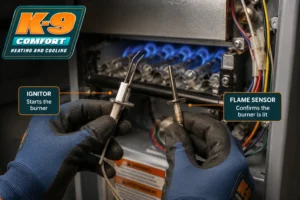
A furnace generates heat. It burns natural gas (or propane, or uses electric resistance) to produce hot air, which your ductwork then distributes throughout the home. Furnaces are straightforward, powerful, and have been the standard in Ohio homes for decades.
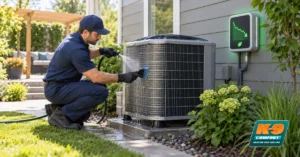
A heat pump, by contrast, doesn’t generate heat — it moves it. In winter, it pulls heat energy from the outdoor air and transfers it inside. In summer, it reverses that process and works exactly like a central air conditioner. As a result, one system handles both heating and cooling, which is a meaningful difference from a cost and convenience standpoint.
The efficiency advantage of a heat pump comes directly from that process. Because moving heat requires far less energy than generating it, a heat pump can deliver two to three times more heating energy than the electricity it consumes on a mild winter day.

The Ohio Climate Factor
This is where location matters most, and it’s worth being direct about it.
Ohio winters are genuinely cold. Marion and the surrounding Central Ohio region regularly see temperatures drop into the single digits and below zero during January and February. Historically, that was the Achilles heel of heat pump technology — older systems struggled to extract heat from very cold outdoor air and lost efficiency rapidly below about 35 degrees Fahrenheit.
Fortunately, modern cold-climate heat pumps have changed that picture significantly. Many of today’s systems — including models from Carrier, Lennox, and Trane — are rated to operate efficiently down to 0 degrees Fahrenheit or below, with some maintaining useful output at -13 degrees or colder.
Even so, Ohio’s climate still means a few things worth knowing:
- A heat pump will work harder and consume more electricity during the coldest stretches of winter than it would in a milder climate like the Southeast or Pacific Northwest
- Homes with poor insulation or significant air leakage will see a bigger efficiency gap between heat pumps and furnaces during cold snaps
- Dual-fuel systems — a heat pump paired with a gas furnace backup — are a popular and practical option in Ohio because they use the heat pump during mild weather and switch to the furnace when temperatures drop hard
Because K9 Comfort takes a diagnostic-first approach, we look at your specific home before recommending one path over another. A 1,200-square-foot well-insulated ranch behaves very differently than a 2,800-square-foot two-story with older windows.
Efficiency: Heat Pump vs Furnace
Efficiency is where heat pumps hold a clear edge under the right conditions.
Furnace efficiency is measured in AFUE — Annual Fuel Utilization Efficiency. A high-efficiency gas furnace typically runs between 96–98% AFUE, meaning nearly all the fuel it burns becomes heat. That’s genuinely impressive performance.
Heat pump efficiency, on the other hand, is measured in HSPF — Heating Seasonal Performance Factor — or COP (Coefficient of Performance). A modern heat pump might deliver a COP of 2.5 to 3.5 during moderate winter conditions, meaning it produces 2.5 to 3.5 units of heat for every unit of electricity it consumes. In efficiency terms, that’s the equivalent of 250–350% AFUE.
The catch, however, is that heat pump efficiency drops as outdoor temperatures fall. During a single-digit Ohio cold snap, that advantage narrows considerably. During a mild Ohio November or March, on the other hand, the difference is dramatic.
Cost Comparison: Upfront and Long-Term
Neither system is cheap to install. Here’s a realistic look at both sides of the cost picture.
| Cost Factor | Gas Furnace | Heat Pump |
|---|---|---|
| Equipment + installation | $3,000 – $6,000 | $4,500 – $10,000+ |
| Replaces AC too? | No (AC separate) | Yes (heating and cooling) |
| Federal tax credit available? | Limited | Yes — up to 30% (IRA 2022) |
| Fuel type | Natural gas | Electricity |
| Avg. monthly operating cost (Ohio) | Moderate — varies with gas prices | Moderate — varies with electricity rates |
| Lifespan | 15–20 years | 15–20 years |
| Maintenance frequency | Annual | Annual (twice if replacing AC too) |
A few things are worth highlighting here. Heat pumps cost more upfront, but they replace both your furnace and your air conditioner — so if you’re also replacing an aging AC at the same time, the cost comparison shifts considerably. Furthermore, the Inflation Reduction Act (2022) made federal tax credits available for qualifying heat pump installations — up to 30% of the cost, capped at $2,000 per year. That’s a meaningful number and worth factoring into your decision.
Gas prices and electricity rates in Ohio fluctuate, and the long-term operating cost comparison between the two systems genuinely depends on what those rates do over time. We won’t pretend to predict that. What we will tell you, though, is that a properly sized and installed heat pump in a well-insulated Ohio home typically delivers competitive operating costs compared to gas — and sometimes lower ones.
What About Existing Ductwork?
Both systems can use your existing ductwork, which matters for installation cost and complexity.
If your home already has a forced-air furnace and central AC, switching to a heat pump is generally straightforward — the existing duct system works well for both. If your ducts are leaky, undersized, or poorly designed, however, that’s a problem worth fixing regardless of which heating system you choose.
If your home has no ductwork at all, a ductless mini-split heat pump is another option worth exploring — especially for additions, older homes, or spaces that are difficult to condition. K9 Comfort can walk you through whether that makes sense for your situation during a consultation.
Heat Pump vs Furnace: Side-by-Side Summary
| Category | Gas Furnace | Heat Pump |
|---|---|---|
| Heat output in extreme cold | Excellent | Good (modern units) / Fair (older units) |
| Efficiency in mild weather | Good | Excellent |
| Upfront cost | Lower | Higher (but replaces AC) |
| Federal incentives | Limited | Yes — up to 30% tax credit |
| Best climate fit | Cold climates | Mild to moderate cold climates |
| Ohio suitability | Strong | Strong (modern cold-climate units) |
| Dual-fuel option | Yes (as backup) | Yes (paired with gas furnace) |
| Lifespan | 15–20 years | 15–20 years |
| Handles cooling? | No | Yes |
What Most Contractors Don’t Tell You
Here’s something that often gets glossed over in heat pump vs furnace conversations: the equipment recommendation should follow the load calculation, not the other way around.
A Manual J load calculation tells you exactly how much heating and cooling your home needs based on its size, insulation levels, window area, air leakage, and local climate data. Without that number, any recommendation — heat pump or furnace — is essentially a guess. An oversized furnace cycles on and off too frequently and wears out faster. Similarly, an undersized heat pump simply can’t keep up on the coldest Ohio nights.
At K9 Comfort, we perform load calculations as part of our replacement process. It’s not an upsell — it’s how honest equipment recommendations get made. You can learn more about how that process works on our load calculation services page.
Which System Is Right for You?
There’s no universal answer, but here’s a practical framework to help you think it through.
A gas furnace is likely the stronger fit if:
- Your home has poor insulation or significant air leakage and you haven’t addressed those issues yet
- Natural gas is available and affordable in your area
- You’re replacing a furnace only and your AC still has years of life left
- Your budget is tighter on the upfront side
A heat pump is likely the stronger fit if:
- You’re replacing both your furnace and your AC at the same time
- Your home is well-insulated or you’re planning efficiency upgrades
- You want to take advantage of available federal tax credits
- You’re interested in a single system for year-round comfort
- You’re considering a dual-fuel setup that optimizes for both efficiency and cold-weather reliability
A dual-fuel heat pump system is worth a serious look if:
- You want the efficiency benefits of a heat pump without giving up the reliability of gas heat during Ohio’s coldest weeks
- You already have a gas line and serviceable ductwork in place
K9 Comfort installs and services both gas furnaces and heat pump systems across Marion and Central Ohio. You can explore your options on our heating services page and our heat pump services page.
The Heat Pump vs Furnace Decision Deserves an Honest Conversation
The heat pump vs furnace question doesn’t have a single right answer — it has a right answer for your home, your budget, and your comfort priorities. What we’d caution against, though, is making that decision based on a quick quote from a contractor who hasn’t looked closely at your home.
K9 Comfort was built on the belief that homeowners deserve clear information and the space to make their own decisions. When you call us, you’ll get a diagnostic-first conversation — not a sales pitch. We’ll look at your home, run the numbers, and give you an honest recommendation along with the reasoning behind it.
FAQ
Is a heat pump good enough for Ohio winters?
Modern cold-climate heat pumps are well-suited for Ohio winters, including periods of extreme cold. Many of today’s units operate efficiently down to 0 degrees Fahrenheit or below. That said, Ohio’s climate is more demanding than milder regions, which is why dual-fuel systems — pairing a heat pump with a gas furnace backup — are a popular and practical choice for Central Ohio homeowners who want the best of both worlds.
Which is cheaper to run — a heat pump or a gas furnace in Ohio?
The answer depends on current gas and electricity rates, your home’s insulation level, and the efficiency rating of the specific equipment. Heat pumps hold a clear efficiency advantage during mild weather, but during Ohio’s coldest stretches, that advantage narrows. Over a full heating season in Central Ohio, the operating costs of a modern heat pump and a high-efficiency gas furnace are often comparable — with the heat pump sometimes coming out ahead during mild winters.
Can a heat pump replace both my furnace and AC?
Yes. A heat pump handles both heating and cooling with a single system. If you’re replacing an aging furnace and your central AC is also due for replacement, a heat pump is worth serious consideration — the cost comparison becomes much more favorable when you’re replacing both systems at once rather than just one.
What is a dual-fuel heat pump system?
A dual-fuel system pairs a heat pump with a gas furnace. During mild and moderately cold weather, the heat pump handles heating efficiently. When temperatures drop below a set threshold — typically around 35 degrees Fahrenheit — the gas furnace takes over automatically. This setup gives Ohio homeowners the efficiency benefits of a heat pump without relying on it during the coldest days of the year.
Do heat pumps qualify for federal tax credits?
Yes. Under the Inflation Reduction Act, qualifying heat pump installations are eligible for a federal tax credit of up to 30% of the cost, capped at $2,000 per year. Income-based rebates may also be available through the HOMES and HEEHRA programs. It’s worth consulting a tax professional for your specific situation, and checking ENERGY STAR’s updated guidance for current eligibility requirements.
Ready to Talk Through Your Options?
Choosing between a heat pump and a furnace is a significant decision, and it’s one worth getting right. The team at K9 Comfort Heating & Cooling is happy to walk you through both options for your specific home — with honest numbers, no pressure, and a documented recommendation you can feel confident in.
Call us: (740) 361-7748
Schedule online: k9comfort.ai/contact-k9-comfort-in-marion
We serve Marion, Delaware, Marysville, Dublin, Lewis Center, Powell, Bucyrus, Upper Sandusky, Sunbury, and the surrounding Central Ohio area. Same family. Same standards. Every visit.
External References
-
- U.S. Department of Energy — Heat Pump Systems: https://www.energy.gov
- ENERGY STAR — Heating and Cooling: https://www.energystar.gov
- Carrier — Heat Pump Technology: https://www.carrier.com
- Lennox — Heat Pump Systems: https://www.lennox.com
- Trane — Heat Pump Products: https://www.trane.com