Most homeowners think about heating and cooling in terms of temperature. However, the air moving through your home every day carries more than just warmth or cool — it carries dust, pollen, moisture, gases, and particles that affect how you feel every single day. K9 Comfort Heating & Cooling works with Central Ohio homeowners to evaluate and improve the air quality inside their homes — not just the temperature of it.
This guide covers what indoor air quality services actually include, what the most common air quality problems look like in Ohio homes, and what solutions genuinely make a difference. If anyone in your household deals with allergies, asthma, frequent illness, or persistent odors, this is worth reading carefully.
Why Indoor Air Quality Matters More Than Most Homeowners Realize
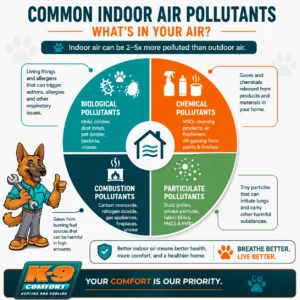
The EPA estimates that Americans spend roughly 90% of their time indoors. Indoor air can be two to five times more polluted than outdoor air — sometimes significantly more. That statistic surprises most people, because indoor air problems are largely invisible.
Central Ohio’s climate compounds the issue in specific ways. Cold winters mean homes stay sealed for months at a time. Fresh outdoor air rarely enters. Pollutants accumulate. Humidity fluctuates dramatically between seasons — too dry in winter, too humid in summer. Both extremes create conditions that affect respiratory health and overall comfort.
Older homes in the Marion and Marysville area add another layer. Many were built before modern ventilation standards existed. They rely heavily on natural air leakage — drafts, gaps, and cracks — rather than controlled ventilation. As homeowners improve insulation and seal air leaks, those natural ventilation pathways disappear. The home becomes more energy efficient but traps more pollutants inside in the process.
What Are Indoor Air Quality Services?
Indoor air quality services cover a range of evaluations and solutions designed to improve the air circulating through your home. They fall into three broad categories: testing and assessment, filtration and purification, and humidity control.
Testing and Assessment
Before recommending any solution, a qualified technician evaluates what’s actually present in your home’s air. This includes checking the HVAC system’s role in air quality — filter condition, coil cleanliness, duct integrity, and ventilation — alongside any environmental factors specific to the home.
K9 Comfort’s diagnostic-first approach applies directly here. We don’t recommend air quality products based on a general assumption that every home needs the same solution. We evaluate your specific home, identify what’s actually affecting your air, and present options based on what the data shows. Learn more about our approach on our air quality services page.
Filtration and Purification
Standard one-inch HVAC filters capture large particles but miss the smaller pollutants that most affect respiratory health. Several upgrades meaningfully improve what your system filters out.
- High-efficiency media filters — thicker filters (4–5 inches) with higher MERV ratings capture significantly more fine particles without restricting airflow the way some thin high-MERV filters do
- UV germicidal lights — installed inside the air handler, UV lights neutralize biological contaminants including mold spores, bacteria, and viruses as air passes through the system
- Electronic air cleaners — use electrical charge to capture ultrafine particles that standard filters miss entirely
- Whole-home air purifiers — integrated into the HVAC system rather than sitting in a single room, these treat all the air moving through your home rather than a portion of it
Humidity Control
Humidity is one of the most overlooked indoor air quality factors in Ohio homes. The ideal indoor relative humidity range is 35–50%. Central Ohio winters regularly push indoor humidity below 30% as heating systems run continuously. Summer humidity frequently pushes above 60% without adequate cooling and dehumidification.
Both extremes cause problems. Low humidity dries out mucous membranes, increases susceptibility to respiratory infections, damages wood floors and furniture, and creates static electricity. High humidity promotes mold and mildew growth, feeds dust mites, and makes the home feel warmer and less comfortable than the thermostat reads.
A whole-home humidifier — installed directly on the HVAC system — maintains consistent humidity through Ohio winters without the maintenance burden of standalone portable units. A whole-home dehumidifier addresses persistent summer humidity that a central AC alone can’t fully control.
Common Indoor Air Quality Problems in Central Ohio Homes
Ohio’s climate and housing stock create a consistent set of air quality challenges. These are the ones K9 Comfort encounters most often across Marion, Marysville, Delaware, and the surrounding service area.
Dust and Particulate Buildup
Forced-air HVAC systems move large volumes of air through ductwork continuously. Without adequate filtration, dust, pollen, pet dander, and other particles circulate repeatedly through the system and settle throughout the home. Symptoms include visible dust accumulation shortly after cleaning, allergy flare-ups indoors, and a stale, heavy feeling to the air.
A clogged or inadequate filter is often the first thing to address. However, dirty ductwork, a contaminated evaporator coil, or gaps in the duct system can all contribute even when the filter is clean.
Mold and Mildew
The evaporator coil inside an air handler sits in a consistently moist environment — condensation is a normal byproduct of the cooling process. When airflow is restricted or the coil isn’t maintained, mold can establish itself on the coil surface and distribute spores throughout the home every time the system runs.
Visible mold near vents, a musty odor when the HVAC runs, or persistent respiratory symptoms that improve when away from home are all worth investigating. UV germicidal lights installed at the coil are one of the most effective long-term solutions for biological contamination in the air handler.
Dry Winter Air
Ohio winters are long and cold. Heating systems run for months without interruption and strip moisture from indoor air in the process. Many Central Ohio homeowners experience dry skin, irritated sinuses, nosebleeds, and increased susceptibility to illness through the winter months — all classic symptoms of chronically low indoor humidity.
A whole-home humidifier integrated into the HVAC system addresses this directly. Unlike portable units that require constant refilling and cleaning, a whole-home system operates automatically and maintains consistent humidity levels throughout every room.
Volatile Organic Compounds (VOCs)
VOCs are gases emitted by a wide range of common household products — paints, cleaning supplies, adhesives, new flooring, furniture, and building materials. They accumulate in poorly ventilated homes and can cause headaches, eye irritation, and respiratory discomfort at elevated concentrations.
Tighter, more energy-efficient homes trap VOCs more effectively than older drafty ones. Improved ventilation — either through mechanical ventilation systems or strategic air exchange — is the primary solution. This is an area where the interaction between energy efficiency and air quality becomes most apparent.
How Your HVAC System Affects Indoor Air Quality
Your heating and cooling system is the engine of your home’s air quality — for better or worse. It moves air continuously through every room. Whatever enters that airstream gets distributed throughout the home.
A well-maintained HVAC system with proper filtration actively improves air quality on every cycle. A neglected system does the opposite — distributing dust, mold spores, and contaminants that have accumulated in the equipment and ductwork.
Several HVAC factors directly affect air quality:
- Filter condition — a clogged filter restricts airflow and allows the system to bypass filtration entirely through gaps around the filter frame
- Coil cleanliness — a dirty evaporator coil reduces efficiency and provides a surface for biological growth
- Duct integrity — leaky ducts pull unfiltered air from attics, crawl spaces, and wall cavities directly into the airstream
- System sizing — an oversized system short-cycles and doesn’t run long enough to filter and dehumidify air properly
Regular HVAC maintenance addresses all of these factors. Our AC maintenance services page covers what a full preventive maintenance visit includes and how it connects to overall home air quality.
Indoor Air Quality Solutions: A Quick Comparison
| Solution | What It Addresses | Best For | Whole-Home? |
|---|---|---|---|
| High-efficiency media filter | Dust, pollen, large particles | Most homes as a baseline upgrade | Yes — via HVAC system |
| UV germicidal light | Mold, bacteria, viruses | Homes with musty odors or allergy concerns | Yes — treats all air through system |
| Electronic air cleaner | Ultrafine particles, smoke | Homes with smokers or fine particle concerns | Yes — via HVAC system |
| Whole-home humidifier | Low winter humidity | Most Central Ohio homes in winter | Yes — via HVAC system |
| Whole-home dehumidifier | High summer humidity | Homes with persistent humidity above 60% | Yes — via HVAC system |
| Mechanical ventilation | VOCs, stale air, CO2 buildup | Tight, well-insulated newer homes | Yes — whole structure |
| Portable air purifier | Localized room air quality | Specific rooms only | No — single room |
Why K9 Comfort Approaches Air Quality Differently
Many HVAC companies recommend air quality products as add-ons at the end of a service call — without evaluating whether the home actually needs them or which solution addresses the specific problem present.
K9 Comfort takes a different approach. Air quality is evaluated as part of the whole-home picture. We look at filtration, humidity, ventilation, and HVAC system condition together — because they all interact. A UV light won’t solve a humidity problem. A humidifier won’t address VOC buildup. The right solution depends on what’s actually affecting your specific home’s air.
We serve Marion, Marysville, Delaware, Dublin, Lewis Center, Powell, Bucyrus, Upper Sandusky, Sunbury, and the surrounding Central Ohio area. Every recommendation comes with a clear explanation of what we found and why we’re suggesting it. You decide what makes sense for your home and your family.
FAQ
How do I know if I have an indoor air quality problem?
Common signs include persistent allergy or asthma symptoms that improve when you leave the home, visible dust accumulation shortly after cleaning, musty or stale odors when the HVAC runs, dry skin and irritated sinuses through winter, and humidity that feels consistently too high or too low. Any of these warrant a professional evaluation.
Do whole-home air quality solutions work better than portable units?
Significantly better for most applications. Portable air purifiers and humidifiers treat a single room and require frequent maintenance. Whole-home systems integrate with your HVAC and treat every cubic foot of air that moves through the system — which in a forced-air home is virtually all of it. For whole-home improvement, whole-home solutions are the right tool.
Can my HVAC system cause indoor air quality problems?
Yes. A dirty evaporator coil, clogged filter, leaky ductwork, or oversized system can all actively worsen air quality. Regular HVAC maintenance is one of the most effective steps a homeowner can take for air quality — not just comfort and efficiency.
What is a MERV rating and what does it mean for my home?
MERV stands for Minimum Efficiency Reporting Value. It measures how effectively a filter captures particles of various sizes. Standard one-inch filters typically carry a MERV rating of 1–4. High-efficiency media filters range from MERV 11–13. Higher isn’t always better — very high MERV ratings on thin filters can restrict airflow in systems not designed for them. A qualified technician can recommend the right MERV rating for your specific system.
Is indoor air quality more of a concern in older or newer homes?
Both have distinct challenges. Older homes often have more air leakage, aging ductwork, and outdated filtration — all of which affect air quality. Newer, tightly built homes have better insulation but less natural ventilation, which causes pollutants and moisture to accumulate more readily. The right air quality strategy depends on the specific home, not just its age.
Ready to Breathe Easier in Your Central Ohio Home?
Indoor air quality isn’t a luxury upgrade — it’s a fundamental part of what makes a home comfortable and healthy to live in. If you’re noticing symptoms, odors, humidity problems, or just want to know what’s actually in your home’s air, K9 Comfort Heating & Cooling is ready to help with a honest, diagnostic-first evaluation.
Call us: (740) 361-7748
Schedule online: k9comfort.ai/contact-k9-comfort-in-marion
We serve Marion, Marysville, Delaware, Dublin, Lewis Center, Powell, Bucyrus, Upper Sandusky, Sunbury, and the surrounding Central Ohio area. Same family. Same standards. Every visit.

External References
- U.S. Department of Energy — Indoor Air Quality and Ventilation: https://www.energy.gov
- ENERGY STAR — Indoor Air Quality: https://www.energystar.gov
- Lennox — Indoor Air Quality Solutions: https://www.lennox.com
- Carrier — Home Air Quality Products: https://www.carrier.com