Most furnaces don’t fail dramatically. They decline gradually — running longer, heating less effectively, costing more to operate month after month — until one cold Ohio morning they stop working entirely. By the time that happens, the signs were almost always there. K9 Comfort Heating & Cooling works with homeowners across Marion, Marysville, Delaware, and Central Ohio to help identify those signs before they become emergencies — and to make honest, data-backed recommendations about what to do next.
This guide covers the seven most common signs your furnace needs to be replaced, what causes each one, and how to think through the repair versus replacement decision without pressure or guesswork.
Why Furnace Replacement Timing Matters in Central Ohio
Ohio winters don’t give much warning. Marion and the surrounding Central Ohio area regularly see temperatures drop into the single digits and below zero during January and February. A furnace that’s limping through fall can fail completely when the load increases in winter — and emergency replacement in the middle of a cold snap is always more expensive and more stressful than a planned replacement in fall.
The right time to evaluate your furnace is before you need it most. That’s why September and October are ideal months to have an honest conversation about where your system stands — and what your options are if it’s approaching the end of its useful life.
Sign #1: Your Furnace Is More Than 15 Years Old
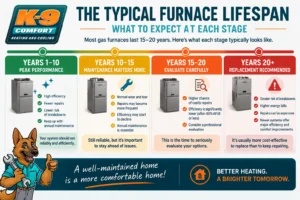
Age is the single most reliable indicator of furnace replacement timing. Most gas furnaces have a functional lifespan of 15–20 years. Systems that receive consistent annual maintenance can reach the upper end of that range. Systems that run without regular service often fail earlier.
Beyond age alone, efficiency tells the real story. A furnace installed 15 years ago might carry an AFUE rating of 80% or lower — meaning 20 cents of every dollar spent on gas produces no usable heat. Modern high-efficiency systems operate at 96–98% AFUE. Over a full Ohio heating season, that efficiency gap shows up directly on monthly gas bills.
If your furnace is over 15 years old and you haven’t had it professionally evaluated recently, that’s the first step — not to be sold something, but to understand where the system actually stands.
Sign #2: Your Energy Bills Keep Climbing
Heating costs naturally vary with weather. A colder-than-average January will produce a higher gas bill than a mild one. However, if your heating bills are consistently higher than they were two or three years ago — without a significant change in weather patterns or home size — your furnace is likely the cause.
Aging furnaces lose efficiency gradually. Heat exchangers develop minor cracks. Burners accumulate buildup. Blower motors wear and draw more electricity. Each of these factors pushes the system to run longer and consume more fuel to deliver the same amount of heat. That inefficiency compounds directly into monthly costs.
A useful benchmark: if your gas bills have increased noticeably year over year without a clear explanation, request an efficiency evaluation before the next heating season. Comparing the cost of running the existing system for another five years against the cost of replacement often makes the decision straightforward.
Sign #3: You’re Calling for Repairs More Frequently
One furnace repair in a year is normal maintenance. Two repairs in a year on an aging system is a pattern worth paying attention to. Three or more repairs in a two-year period on a furnace over 12 years old is a strong signal that the system is in decline.
Furnaces tend to fail in clusters toward the end of their lifespan. Components that have been running for 15 years wear out at similar rates — so a capacitor failure this fall may be followed by a heat exchanger issue in winter and a control board failure in spring. Each repair on an aging system is borrowed time rather than a long-term solution.
A practical rule of thumb: if a single repair costs more than 50% of the system’s current market value, replacement is almost always the better financial decision. A trustworthy HVAC company will show you both numbers and let you decide. Our heating services page outlines what a replacement evaluation looks like from start to finish.
Sign #4: Your Home Heats Unevenly
A furnace in good working order maintains consistent temperatures throughout the home. Rooms that are significantly colder than others, persistent cold spots near exterior walls, or a second floor that never reaches the same temperature as the first floor are all signs that something in the system isn’t working correctly.
Uneven heating has several possible causes. Duct leakage is one — conditioned air escaping into unconditioned spaces before it reaches living areas. A failing blower motor is another — the motor that pushes air through the duct system may no longer produce adequate airflow. A declining heat exchanger can also reduce effective heat output even when the burner appears to be operating normally.
Some causes of uneven heating are repairable. Others are symptomatic of a system in overall decline. A diagnostic evaluation identifies which situation applies — and whether repair or replacement is the right path forward.
Sign #5: Your Furnace Is Making New or Unusual Noises
A furnace that has run quietly for years and suddenly develops new sounds is communicating something worth listening to. Different sounds point to different problems.
- Banging or booming at startup — almost always delayed ignition. Gas accumulates before lighting and ignites with force. This stresses the heat exchanger and can cause cracks over time. Do not ignore this sound.
- Squealing or screeching — typically a blower motor bearing failing or a worn belt on older systems. Usually repairable, but a sign of age.
- Rattling during operation — could be loose panels, a failing inducer motor, or debris in the blower. Worth investigating promptly.
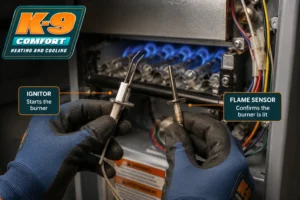
- Clicking that repeats without ignition — the ignitor is attempting to fire but failing. The gas valve, ignitor, or flame sensor likely needs attention.
- Rumbling after the burner shuts off — often indicates dirty burners or a problem with combustion. Have this evaluated before the next heating season.
On an older furnace, multiple new sounds appearing within the same season are a meaningful warning sign. Each sound represents a component under stress — and stressed components on aging systems tend to fail in sequence.
Sign #6: Your Furnace Has a Yellow or Flickering Flame
A properly operating gas furnace burns with a steady blue flame. A yellow, orange, or flickering flame is a warning sign that demands immediate attention — it can indicate incomplete combustion and the potential presence of carbon monoxide.
Carbon monoxide is colorless and odorless. A cracked heat exchanger — one of the most serious furnace problems — allows combustion gases including carbon monoxide to enter the airstream and circulate through your home. Signs that may accompany a carbon monoxide issue include headaches, dizziness, or flu-like symptoms that improve when you leave the house, streaks of soot around the furnace, and excessive condensation on windows.
If you observe a yellow or flickering flame, turn the furnace off and call a licensed HVAC technician immediately. Do not operate the system until it has been inspected. A cracked heat exchanger on an aging furnace is one situation where replacement — rather than repair — is almost always the honest recommendation.
Sign #7: Your Home Feels Dry or Dusty Despite Regular Cleaning
Older furnaces lose their ability to properly moisturize and filter the air circulating through the home. If your home feels excessively dry in winter — cracked lips, dry skin, static electricity, wood floors shrinking — or if dust accumulates quickly after cleaning, your furnace may be contributing to the problem.
Modern furnaces are designed to work in conjunction with whole-home humidification and advanced filtration systems. Older systems running at reduced efficiency also tend to short-cycle — turning on and off more frequently — which reduces the system’s ability to filter and condition air adequately during each cycle.
Persistent air quality and humidity issues that develop alongside an aging furnace are often resolved as a byproduct of replacement. Our air quality services guide covers how heating system performance and indoor air quality interact — and what options exist for homeowners dealing with both issues simultaneously.

Signs Your Furnace Needs to Be Replaced: A Quick Reference
| Warning Sign | Urgency | Likely Next Step |
|---|---|---|
| Furnace over 15 years old | Plan ahead | Schedule evaluation before heating season |
| Rising energy bills | Moderate | Efficiency assessment — compare repair vs. replace |
| Frequent repairs | Moderate to high | Calculate repair cost vs. replacement value |
| Uneven heating throughout home | Moderate | Diagnostic evaluation — identify root cause |
| New or unusual noises | Moderate to high | Service call — some sounds require urgent attention |
| Yellow or flickering flame | Urgent | Turn off system — call for service immediately |
| Excessive dryness or dust | Lower urgency | Evaluate as part of overall system assessment |
Repair vs. Replace: How to Think Through the Decision
The repair versus replacement decision doesn’t have a universal answer — it has a right answer for your specific furnace, your home, and your budget. Here’s a practical framework.
Replace is almost always the better choice when:
- The furnace is over 15 years old and requires a major repair
- The repair cost exceeds 50% of the system’s current replacement value
- The heat exchanger is cracked — this is a safety issue and a major expense on aging equipment
- Multiple components have failed in a short period
- Energy bills have increased significantly despite recent repairs
Repair may still make sense when:
- The furnace is under 10 years old and the repair is straightforward and well-priced
- The system has been properly maintained and shows no other signs of decline
- The repair is minor relative to the system’s remaining useful life
At K9 Comfort, we never recommend replacement without showing you the reasoning behind it. Every evaluation includes documented diagnostic findings and a clear comparison of repair cost versus replacement value — so you have the information to make the right decision for your home. You can learn more about how we approach furnace replacement on our heating services page.
FAQ
How long should a furnace last in Central Ohio?
A well-maintained gas furnace typically lasts 15–20 years in Central Ohio. Systems that receive annual professional maintenance tend to reach the upper end of that range. Systems that run without regular service — or that were incorrectly sized when installed — often fail earlier. If your furnace is approaching 15 years, an annual evaluation is the most reliable way to stay ahead of an unexpected failure.
Is it worth repairing a furnace that’s over 15 years old?
It depends on the nature and cost of the repair. Minor repairs on a 15-year-old furnace in otherwise good condition may still make sense. Major repairs — heat exchanger replacement, control board failure, inducer motor replacement — on a furnace over 15 years old almost always tip the scale toward replacement. A reputable HVAC company will show you the numbers on both options before recommending anything.
What are the signs of a cracked heat exchanger?
Signs of a cracked heat exchanger include a yellow or flickering flame, visible soot or streaks near the furnace, headaches or dizziness that improve when you leave the home, a carbon monoxide alarm triggering, and a flame that flickers or moves when the blower turns on. A cracked heat exchanger is a carbon monoxide risk. If you suspect one, turn the system off and call a licensed technician immediately.
How much does furnace replacement cost in Central Ohio?
Furnace replacement costs in Central Ohio typically range from $3,000 to $6,000 depending on the system size, efficiency rating, and installation complexity. High-efficiency systems cost more upfront but deliver meaningfully lower operating costs over their lifespan — especially in Ohio’s long heating seasons. A proper load calculation ensures you’re replacing with the correctly sized system, not just matching the old one.
Should I replace my furnace before it completely fails?
Yes — when the signs are there. Planned replacement in September or October is almost always less expensive and less stressful than emergency replacement in January. You have time to evaluate options, get accurate quotes, and choose the right system for your home. An emergency replacement during a cold snap may limit your options and compress the decision timeline in ways that don’t favor you.
Don’t Wait for Your Furnace to Fail on the Coldest Night of the Year
The signs your furnace needs to be replaced rarely appear all at once. They accumulate gradually — a higher bill here, a new noise there, a repair that seemed reasonable at the time. By the time the system fails completely, most homeowners look back and realize the writing was on the wall.
K9 Comfort Heating & Cooling offers honest furnace evaluations across Central Ohio — documented findings, clear options, and no pressure to buy something you don’t need. If your furnace is showing any of the signs above, the right time to have the conversation is before heating season, not during it.
Call us: (740) 361-7748
Schedule online: k9comfort.ai/contact-k9-comfort-in-marion
We serve Marion, Marysville, Delaware, Dublin, Lewis Center, Powell, Bucyrus, Upper Sandusky, Sunbury, and the surrounding Central Ohio area. Same family. Same standards. Every visit.
External References
- U.S. Department of Energy — Furnace Efficiency and Replacement: https://www.energy.gov
- ENERGY STAR — Furnaces and Heating Equipment: https://www.energystar.gov
- Carrier — Furnace Products and Lifespan: https://www.carrier.com
- Lennox — When to Replace Your Furnace: https://www.lennox.com
- Trane — Heating Systems: https://www.trane.com