
It’s one of the most common questions homeowners ask when replacing their air conditioner — and one of the most frequently answered incorrectly. Getting the right size AC unit isn’t about matching what was there before. It’s about understanding what your specific home actually needs. K9 Comfort Heating & Cooling works with Central Ohio homeowners every day to answer this question the right way — with real data, not guesswork.
In this guide, we’ll explain how AC sizing actually works, why the wrong size costs you more than you’d expect, and what the proper sizing process looks like. Whether you’re replacing an aging system or buying for the first time, this is what you need to know before making the decision.
Why AC Unit Size Matters More Than Most Homeowners Realize
AC sizing isn’t just a technical detail. It directly affects how comfortable your home feels, how much you pay to run the system, and how long the equipment lasts.
An air conditioner that’s too small runs constantly. It struggles to reach the set temperature on the hottest Ohio days. It wears out faster and drives up your electric bill month after month.
An air conditioner that’s too big creates a different set of problems. It cools the air quickly but shuts off before completing a full cycle. That process — called short-cycling — means the system never runs long enough to remove humidity from the air. The result is a home that feels cold and clammy at the same time. Short-cycling also puts extra stress on the compressor, shortening the equipment’s lifespan significantly.
Neither outcome is acceptable. Both are avoidable with proper sizing upfront.
What Does AC Unit Size Actually Mean?
When HVAC professionals talk about AC size, they’re referring to cooling capacity — measured in BTUs (British Thermal Units) per hour, or more commonly in tons. One ton of cooling capacity equals 12,000 BTUs per hour.
Residential systems typically range from 1.5 tons to 5 tons. A common rule of thumb suggests one ton per 400–600 square feet of living space. However, that rule exists as a rough starting point — not a final answer. It ignores too many variables that significantly affect how much cooling your home actually needs.
Square footage is just one piece of the puzzle. The following factors all influence the correct size for your specific home:
- Ceiling height — taller ceilings mean more air volume to condition
- Insulation quality — poorly insulated homes lose conditioned air faster
- Window area and orientation — south and west-facing windows add significant heat load
- Air leakage — drafty homes require more cooling capacity to compensate
- Local climate — Ohio’s humidity adds latent cooling load beyond temperature alone
- Number of occupants — people generate heat that the system must account for
- Shading and landscaping — trees and overhangs reduce solar gain meaningfully
Ignoring these variables produces an inaccurate size recommendation. Accurate sizing requires a proper calculation — which brings us to the most important tool in the process.
The Manual J Load Calculation: The Only Accurate Way to Size an AC Unit
The Manual J load calculation is the industry-standard method for determining exactly how much heating and cooling a home requires. It accounts for every variable listed above and produces a specific BTU number tailored to your home’s actual characteristics.
Manual J is not a quick estimate. It requires measurements, insulation assessments, window data, and local climate inputs. When performed correctly, it takes time — and that time is worth it. The result is a system recommendation backed by real numbers rather than assumptions.
Unfortunately, many HVAC companies skip the full Manual J process. Some use simplified software estimates. Others simply match the size of the existing system and move on. Both approaches leave homeowners at risk of ending up with the wrong equipment — and paying for that mistake for years afterward.
At K9 Comfort, a load calculation is a standard part of every replacement evaluation. We don’t recommend equipment without knowing what your home actually needs. You can learn more about how we approach this on our load calculation services page.
AC Sizing in Ohio: Why the Climate Adds Complexity
Ohio’s climate creates specific sizing challenges that a generic national calculator doesn’t fully capture. Central Ohio summers combine heat and humidity in a way that puts dual demands on your air conditioning system.
Sensible cooling handles air temperature. Latent cooling handles moisture removal. Ohio summers require meaningful capacity in both categories. A system sized purely for temperature — without accounting for humidity load — will leave your home feeling uncomfortable even when the thermostat reads correctly.
Additionally, Ohio’s shoulder seasons matter. Spring and fall in Central Ohio can swing dramatically — warm afternoons followed by cool nights. A properly sized system handles those variations efficiently. An oversized system short-cycles through them, wasting energy and accelerating wear.
Central Ohio homes also vary widely in construction vintage. Older Marion and Marysville homes from the 1960s and 1970s have very different heat gain profiles than newer construction in Lewis Center or Dublin. A 2,000-square-foot ranch from 1972 and a 2,000-square-foot two-story from 2018 are not the same cooling problem — even though the square footage matches.
Common AC Sizing Mistakes and How to Avoid Them
Several patterns come up repeatedly when homeowners end up with the wrong system size. Knowing them helps you ask the right questions before committing to a purchase.
Replacing like-for-like without questioning the original size. The previous system may have been incorrectly sized when it was installed. Replacing it with the same tonnage carries the original mistake forward. Always ask whether a load calculation was performed.
Trusting a quick phone estimate. A legitimate equipment recommendation cannot be made without visiting the home and gathering data. Any company that quotes a specific size over the phone without an in-home assessment is guessing.
Choosing a bigger system to be safe. Bigger is not better with air conditioning. As covered above, an oversized unit creates humidity problems, short-cycling, and premature equipment failure. More capacity does not equal more comfort.
Ignoring recent home improvements. New insulation, window replacements, or additions change your home’s cooling load. A load calculation performed before those improvements may no longer reflect current conditions.
What the Right AC Sizing Process Looks Like With K9 Comfort
When you call K9 Comfort for an AC replacement evaluation, here’s what actually happens:
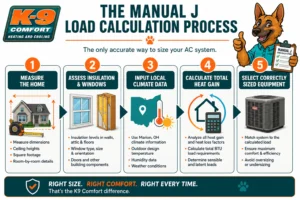
- We visit your home and take measurements — room by room, not just total square footage
- We assess insulation levels, window area, orientation, and air leakage
- We input your home’s data along with local Central Ohio climate figures
- We run the Manual J calculation and determine your home’s actual cooling load
- We present you with equipment options sized to that load — with the reasoning explained clearly
- You make the decision with full information in hand
No pressure. No upsell. No equipment recommendation before the math supports it. That’s K9 Comfort’s diagnostic-first approach applied to every replacement conversation. Our AC replacement services page covers what the full replacement process looks like from evaluation through installation.
AC Unit Size Quick Reference: Ohio Homes
The table below provides a general starting point — not a final recommendation. Always confirm with a proper Manual J calculation before purchasing equipment.
| Home Size (Sq Ft) | Estimated Tonnage | Notes for Ohio Homes |
|---|---|---|
| Up to 1,000 | 1.5 tons | Adjust for ceiling height and insulation |
| 1,000 – 1,500 | 2 tons | Older homes may need more due to air leakage |
| 1,500 – 2,000 | 2.5 tons | Window orientation affects this range significantly |
| 2,000 – 2,500 | 3 tons | Ohio humidity adds latent load — don’t undersize |
| 2,500 – 3,000 | 3.5 – 4 tons | Two-story homes distribute load differently |
| 3,000+ | 4 – 5 tons | Always requires full load calculation |
FAQ
Can I just replace my AC with the same size as the old one?
You can — but it isn’t always the right decision. The previous system may have been incorrectly sized when first installed. Additionally, home improvements like new insulation or windows change your home’s cooling load. A Manual J load calculation confirms whether the existing size is still appropriate before you commit to new equipment.
How do I know if my current AC is the wrong size?
Common signs of an oversized system include rooms that feel clammy even when cool, a system that turns on and off frequently in short bursts, and humidity problems in summer. Signs of an undersized system include the AC running constantly, rooms that never reach the set temperature on hot days, and higher-than-expected energy bills.
Does AC size affect energy bills?
Yes — significantly. An oversized system short-cycles and runs inefficiently. An undersized system runs constantly and still underperforms. Both scenarios waste energy and increase monthly costs. A properly sized system runs in longer, more efficient cycles and removes humidity effectively, which is where real comfort and savings come from.
How long does an AC sizing assessment take?
A proper in-home load calculation typically takes one to two hours depending on home size and complexity. That time investment protects you from years of poor performance and unnecessary repair costs. At K9 Comfort, this assessment is a standard part of every replacement conversation — not an upsell.
What if my home has been renovated since the last AC was installed?
Renovations change your home’s cooling load. New insulation, window replacements, room additions, and finished basements all affect the calculation. If your home has changed meaningfully since the last system was installed, a fresh load calculation is the right starting point before selecting new equipment.
Get the Right Size AC Unit for Your Ohio Home
Choosing the wrong size air conditioner is one of the most common and costly mistakes Ohio homeowners make — and one of the easiest to avoid. The answer to “what size AC unit do I need” isn’t a rule of thumb. It’s a number that comes from a proper load calculation performed on your specific home.
K9 Comfort Heating & Cooling performs that calculation on every replacement evaluation — no guesswork, no assumptions, no equipment recommendations before the data supports them. If you’re ready to get it right, we’re ready to help.
Call us: (740) 361-7748
Schedule online: k9comfort.ai/contact-k9-comfort-in-marion
We serve Marion, Marysville, Delaware, Dublin, Lewis Center, Powell, Bucyrus, Upper Sandusky, Sunbury, and the surrounding Central Ohio area. Same family. Same standards. Every visit.
External References
- U.S. Department of Energy — Sizing Home Cooling Equipment: https://www.energy.gov
- ENERGY STAR — Central Air Conditioning: https://www.energystar.gov
- Carrier — Air Conditioner Sizing Guide: https://www.carrier.com
- Lennox — Choosing the Right AC Size: https://www.lennox.com